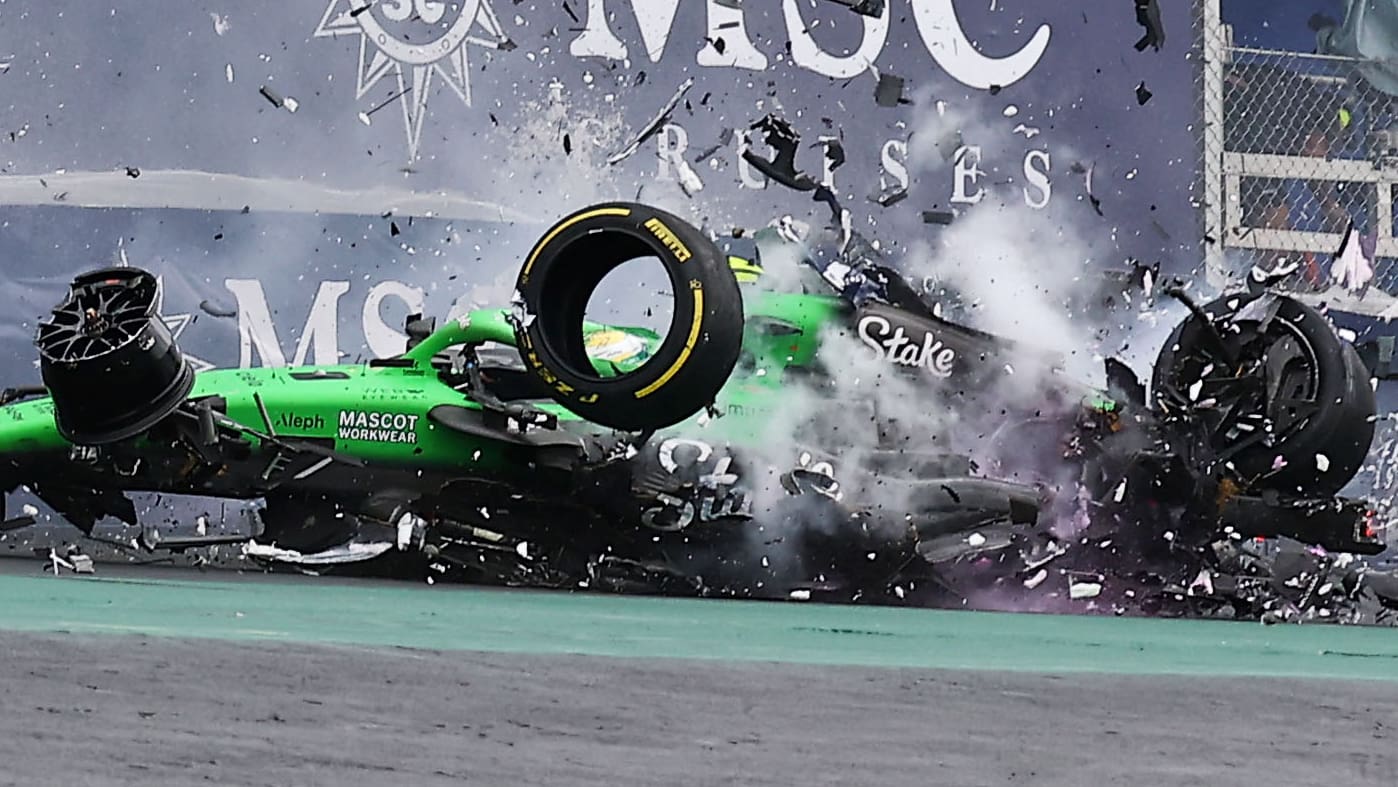

Formula 1 crash tests decide whether a car ever races. From carbon monocoques to 2026-era impacts, this is how the FIA destroys cars on purpose, and why it makes drivers faster. It’s the science, the sacrifice, and the survival logic behind motorsport’s most brutal gatekeeping process.
These tests are not simulations. They are executions. Before a car is allowed anywhere near a circuit, it is deliberately destroyed under FIA supervision. Nose cones are smashed. Side structures crushed. Roll hoops overloaded. Steering columns fired at with ballistic precision. If any element fails outside unforgiving tolerances, the car does not race. There are no exemptions. No compromises. Safety is a non-negotiable.
This is how Formula 1 keeps its drivers alive at speeds where survival should be statistically impossible.
The philosophy: control the violence
Modern Formula 1 safety is not about building indestructible cars. It is about ensuring they fail in controlled, predictable ways. The FIA emphasizes energy absorption in controlled areas rather than invincibility. At the centre of every test is the survival cell, a carbon fibre monocoque surrounding the driver. This structure must remain intact in every regulated scenario. Moreover, verything attached to it is designed to absorb, redirect, or dissipate energy before it reaches the cockpit. Crash tests exist to validate one non-negotiable principle: the car sacrifices itself so the driver does not.
Dynamic impact tests
- Frontal impact
A complete chassis is fired into a deformable barrier at roughly 15 metres per second. The nose structure must absorb energy progressively, keeping peak deceleration within strict limits. Too stiff and the forces spike. Too soft and the survival cell is threatened. The FIA mandates frontal impact tests at around 14 m/s, with strict deceleration limits to protect the monocoque. - Side impact
A hydraulic ram strikes the side of the chassis with immense force. Anti-penetration panels, typically reinforced with Zylon, must prevent intrusion into the cockpit. Engineers measure deformation in millimetres, not centimetres, to reflect the precision required for cockpit protection. Side-impact tests ensure the survival cell always remains intact. - Rear impact
The rear structure is tested to protect the gearbox, fuel cell, and hybrid systems. Failure here risks fire, secondary impacts, or both. The FIA designs rear crash tests to absorb energy in a controlled way and safeguard critical components. - Steering column test
An eight-kilogram mass is fired into the steering wheel at speed. The column must collapse in a controlled manner, absorbing energy without breaking or jamming. Moreover, the quick-release must still function afterwards. Steering column tests ensure that the driver can exit the car quickly, even after an impact.
Fail any one of these tests and the design goes back to the drawing board. Cars must pass all prescribed crash tests before being allowed on track.
Finally, every piece of the car is engineered to fail so that the driver does not, that is the essence of controlling the violence.
Static load tests
Static tests rarely make headlines, but they are unforgiving. Extreme vertical, lateral, and longitudinal loads act on the roll structures above the driver’s head. FIA squeeze and load the chassis sides, floor, and bulkheads until they are sure they will not collapse or intrude under worst-case forces.
For 2026, these load requirements increase again, particularly around roll hoop strength and side intrusion resistance. This reflects both heavier cars and lessons learned from real accident data.
The survival cell: Non-negotiable core
The survival cell is at the heart of every Formula 1 car. It is made of numerous layers of ultra-high-strength carbon fibre and is intended to remain intact even if everything else linked to it disintegrates. Kevlar and Zylon layers prevent penetration from debris, loose wheels, and sharp carbon pieces.
The fuel cell sits within this structure, rubberised and heavily protected. The driver’s seat, belts, headrest, halo and steering column are integrated as a single safety system. If the survival cell fails, the car is deemed unacceptable. There is no appeal.
Why crash tests make drivers faster?
Crash tests do more than just enhance survival skills; they also boost confidence. Drivers who trust their cockpits can stop later, commit earlier, and push harder in difficult scenarios such as street circuits, rainy restarts, or first-lap traffic. Confidence translates to lap time.
A reliable safety cell enables engineers to optimise weight, packaging, and aerodynamics elsewhere. Safety is not a limitation; rather, it enables it.
The Data Loop: When Accidents Rewrite the Rules
Formula 1 develops safety regulations based on analyses of real-world events. Acceleration traces, intrusion measurements, and medical outcomes all influence rule changes.
Key Examples
1994, Ayrton Senna: Fatal head injuries revealed flaws in cockpit protection and chassis stiffness, changing crash structural design and energy absorption theories.
2014, Jules Bianchi: A high-speed crash with a recovery vehicle revealed secondary collision dangers, prompting the implementation of cockpit protective devices like as the halo.
2020, Romain Grosjean: A 67g collision and post-crash fire were used to test the survival cell, halo, and fuel system. The cockpit worked as intended; the driver lived.
Regulations will tighten again in 2026, with stronger roll structures, increased side incursion resistance, and perfected multi-stage energy absorption, not reactively, but proactively.
Beyond The Grid
What Formula One learns from damaging its own cars does not remain in the paddock. Composite safety constructions, penetration-resistant materials, and energy management techniques developed in Formula One have an impact on endurance racing, GT regulations, and, eventually, road-car safety research.
F1 industrialises survival by developing materials and designs that assist both motorsport and the larger automobile sector.
The Bottom Line
Crash tests serve as the quiet underpinning for Formula One. They rarely make headlines unless something goes wrong, yet when everything works out, drivers survive collisions that would have killed them decades ago.
These tests do not slow Formula One down; they make it feasible.
- F1 Flashbacks: A look back at four of the greatest rivalries within the sport

- Pioneering Women Drivers in IndyCar History

- Think you know F1? Prove It

- F1 Academy: What is the Three Race Format?

- The End of an Era: Verstappen and Lambiase to Split After 2027

About The Author

Leave a Reply