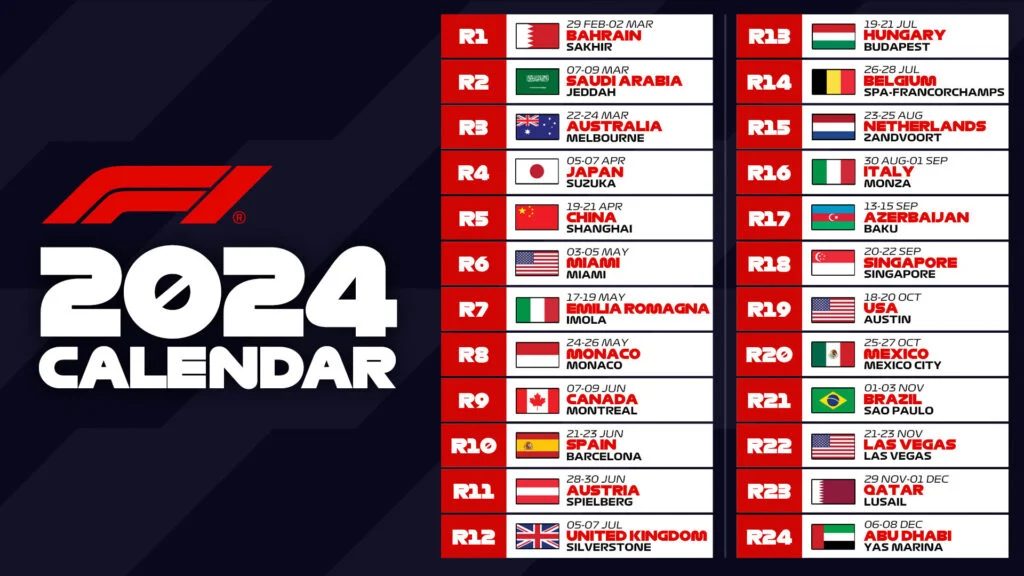

The 2024 season featured 24 race weekends spanning from March to December. To optimize travel and logistics, there was an effort to group races by continent and region. While some countries requested specific date slots, the overall schedule prioritized efficiency.
Originally, the goal was to match the 24-race calendar of 2023. However, the Chinese Grand Prix was cancelled due to COVID-19 restrictions, and the Emilia Romagna Grand Prix was postponed due to flooding. As a result, 2024 became the longest-ever Formula One season, fulfilling all 24 race weekends.
The season kicked off in the Middle East, with races held on Saturdays to accommodate the Muslim holiday of Ramadan, which began on 10th March, immediately after the Saudi Arabian Grand Prix. The teams then traveled to Australia, Japan, and China, completing the Asian leg of the calendar. This sequential arrangement was designed to streamline travel and logistics.
The placement of the Miami Grand Prix between the Asian and European sectors might seem unusual. It could have been grouped with the other American races. However, its inclusion offers logistical advantages, whether strategically placed to avoid conflicts with other sporting events or to enhance its unique appeal as a standalone event between the Asian and European legs.
The European leg concluded in Italy before moving to Azerbaijan and Singapore, two geographically proximate locations in the Asian region. The championship then returned to the Americas for races in the United States, Mexico, and Brazil. The final two races were held in the Middle East, in Qatar and Abu Dhabi.
To minimize unnecessary travel between continents, the calendar was designed to accommodate triple-header events and a larger number of races. However, this increased schedule was a significant financial burden for smaller teams, particularly in terms of travel costs, upgrades, and potential damage repairs.
While there have been calls to add races in South Korea and African countries, it seems that the 24-race limit will remain in place for the foreseeable future. Some tracks may lose their contracts as new venues are introduced. Nevertheless, Formula One has emphasized a balance between tradition and evolution, ensuring that iconic circuits continue to be part of the calendar.
“No, seriously, the request is very, very big. It is up to us to make the right choices. But the number is set at 24. It will stay 24. Don’t forget that five years ago we were at 17 or 18 … There is a provision that we need to make sure the races need to be respected, but that doesn’t mean there is a duty.” (Stafano Domincali, current CEO for the Formula One Group told ESPN earlier this year when discussing the Formula One calender. Read his full thoughts here: F1 CEO Clarifies Stance On Expanding The Formula One Calendar As Interest To Join Inc )
Written by Isha.
Featured Image Credit: corp.formula1.com
About The Author


Leave a Reply