
Monaco wasn’t chaos or carnage. It wasn’t even remotely exciting, at least not on the surface. Under the weight of its generational boredom came something far stranger: a race that revealed more in its silences than its sparks. Yes, it was that kind of Grand Prix, and that’s sort of the problem.
This track; narrow, short, and better suited to 1985-sized cars, has become increasingly allergic to overtaking. With modern cars resembling city buses in width, passing is basically impossible without divine intervention. This is why, year after year, whispers get louder about whether Monaco still deserves a spot on the calendar. The tradition is iconic, but the racing not so much.
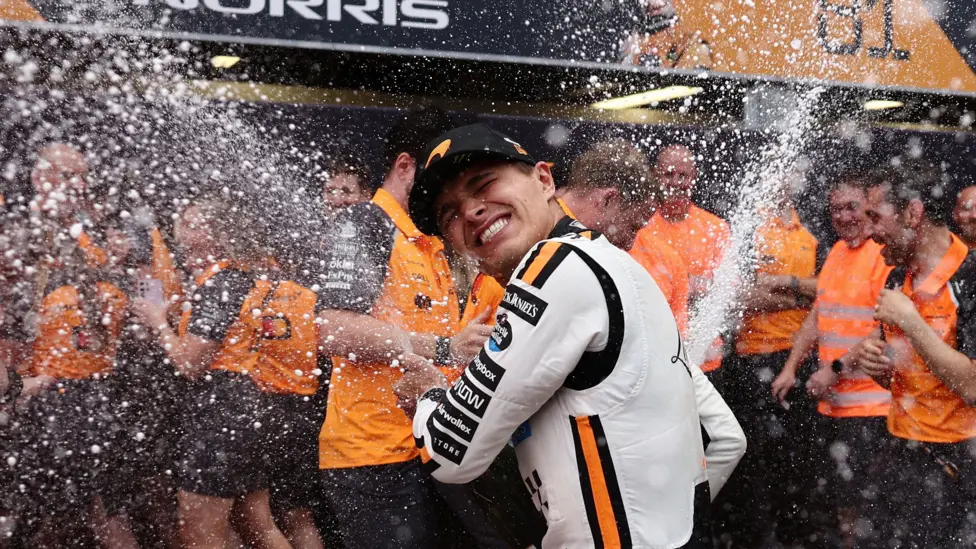
Lando Norris won it, but to call it a fight would be stretching the definition. His race was more about managing tempo than attacking. Every lap ticked by like clockwork: no wheelspin, no misstep, no tension. It was quite dull to watch, but it was effective. In Monaco, methodical racing is what gets the trophy.

Behind him, Charles Leclerc found peace on home soil. There was no heartbreak, no sabotage, nor DNF. He came in second, and for a driver whose Monaco history is basically written in red flags and regret, that was a massive win, despite finishing a place lower than last year. Ferrari didn’t fumble the strategy as it has in times past. For once, both red cars actually saw the flag; Leclerc on the podium, Hamilton not far behind. That alone felt like a minor miracle.
Further back, things got weird. George Russell, boxed in behind Alex Albon with no hope of a clean pass, decided he’d had enough and launched over the chicane like he’d unlocked a cheat code. It was a bold and impatient move. While he may have looked clever in the moment, it turned out to be a waste of time because it bought him precisely nothing. The stewards handed him a drive-through penalty, and by the time it was served, he was staring at the same Williams gearbox he thought he’d left behind. Monaco doesn’t forget, and it definitely doesn’t forgive.
Russell, boxed in and visibly fed up, accused Albon on the radio of brake-checking the field, not that it mattered since everyone was going slow on purpose. The new two-stop rule had turned Monaco into a moving chessboard where entire cars were sacrificed to buy time for teammates. Liam Lawson was such a team player for VCARB, and did it for Isack Hadjar.
Lawson dragged half the grid into a parade formation just so his teammate could pit twice without falling behind, and it technically worked. Both Racing Bulls scored points (with Hadjar in P6 and Lawson P8), which is impressive, if you ignore the fact that one of them had to become a moving barrier to make it happen. Tactical? Yes. Inspiring? Not quite.

As for Max Verstappen, his car sounded like it was borrowed from a museum. “My shifts feel like Monaco Grand Prix 1972,” he groaned over the radio. The RB21 looked twitchy, and Verstappen may have never quite trusted it. He still salvaged fourth position, but the undefeatable aura that used to surround him has dimmed. His Red Bull doesn’t scare drivers any longer.
Elsewhere, there was a collision between Pierre Gasly and Yuki Tsunoda that ended Gasly’s race. It was one of the few things that actually happened in this Grand Prix, but they were both backmarkers, so it didn’t exactly shake the order. Tsunoda called Gasly “an idiot” over the radio, while Gasly’s car sat dead in the run-off. That was about as much drama as the race could offer, aside from Lap 1, when Gabriel Bortoleto found the barriers after accusing Kimi Antonelli of shoving him off. Bortoleto was still able to rejoin, and Monaco rolled on like nothing happened.
Fernando Alonso’s final contribution to this race was a shouted “I can’t!” when asked to push; the car had nothing left and neither did he. His yell sounded made it clear that he felt there was no point. His retirement came quietly, not really affecting the race, but his frustration didn’t.
And finally, because it wouldn’t be Monaco without one more bizarre footnote, the race got so slow and so uneventful that Formula One actually aired a Pierre Gasly interview during the Grand Prix, not post-race. The driver had already crashed out and was still more active than half the grid who were still racing. When the most exciting moment is an out-of-context quote from a driver no longer in the race, you know something’s gone sideways.
Monaco 2025 fizzled, rather than exploding. Even that, howeverm told us something: McLaren is consistent, Ferrari is confused, Red Bull is cracked, and Lawson might just be the quietest tactician in the sport. Sometimes, even when nothing happens, everything does.
Written by Krystal.
Featured Image Credit: bbc.co.uk
About The Author


Leave a Reply