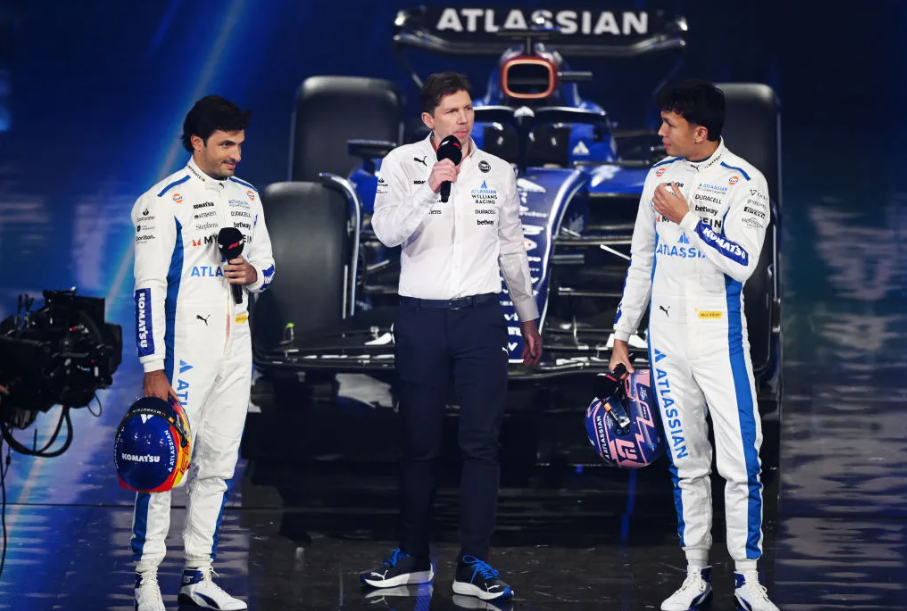

The 2025 Formula 1 season will be remembered as the year Williams Racing shed its back marker label, completing a remarkable transformational under the leadership of Team Principal James Vowles.
Finishing 5th in the Constructors’ Championship with 137 points, achieving their best result since 2017, proving that their long-term project is ahead of schedule.
Technical Analysis: The Engineering Behind the Leap
The FW47 wasn’t just a faster version of the FW46, it was a fundamental rethink of how a Williams car interacts with the track. Under technical leaders like Pat Fry (Chief Technical Officer), the team addressed the issues of the past.
- The Journey:
In 2024, Williams started the season significantly overweight, essentially carrying cargo they didn’t want. The FW47 hit the minimum weight limit of 798 kg from the first day. This allowed engineers to use movable ballast to optimize the car’s balance for different tracks, a luxury they didn’t had in years. - Rear Suspension Revolution:
Williams finally adopted the Mercedes 2025 pushrod rear suspension.
– Old Design: Better for a lower center of gravity but cluttered the airflow around the diffuser.
– New Design: Cleared “aerodynamic real estate” at the back of the car. By moving the suspension components upwards, engineers opened up a cleaner path for air to reach the diffuser, drastically increasing high-speed downforce. - “Anti-Dive” Geometry:
To give Alex Albon and Carlos Sainz more confidence under heavy breaking, Williams increased the anti-dive on the front suspension. This kept the car’s nose from dipping too sharply, while maintaining a stable aerodynamic platform when entering corners like Turn 1 in Monza or the hairpins in Montreal.
The Driver Duel: Experience vs. Adaptability
The Albon-Sainz pairing was a study in two different mindsets. While the points table looked lopsided for the first half of the year. Data however, tells a story of an incredibly close fight.
- Season Stats
| Metric | Alex Albon | Carlos Sainz |
| Final Points | 73 | 64 |
| Best Result | P5 (x3) | P3 (x2) |
| Qualifying H2H | 9 | 15 |
| Race H2H | 14 | 10 |
| DNF/DNS | 1 | 3 |
- The Dynamic
– Alex Albon: Having spent years at Grove, Alex knew exactly how to compensate for the car’s lingering “laziness” in low-speed corners. His 14-10 race record reflects his superior ability to manage the tires over a full Grand Prix distance in a car he knew like the back of his hand.
– Carlos Sainz: Sainz brought his Ferrari-level to Saturday afternoons. His 15-9 qualifying advantage was a wake-up call for the team, proving the FW47 had raw pace that hadn’t always been extracted before. His two podiums in Baku and Qatar were major hallmarks of his tactical defense, when he showed he could handle the pressure when a trophy was on the line.
Final Verdict and What’s next?
Williams succeeded in 2025 as they developed into a well rounded team. Although concerns about their cooling issues in high-summer races still linger for the 2026 power unit transition, the team has proven they have enough firepower ro out develop their competitors like Alpine and Haas.
The signs are most definitely with Grove. Having a consistent driver line-up and a car that is finally “on the weight” the question for 2026 is no longer if they can score point but how soon can they become contenders for wins.

Marcia
Featured image credit: Rolling Stones
About The Author

Leave a Reply