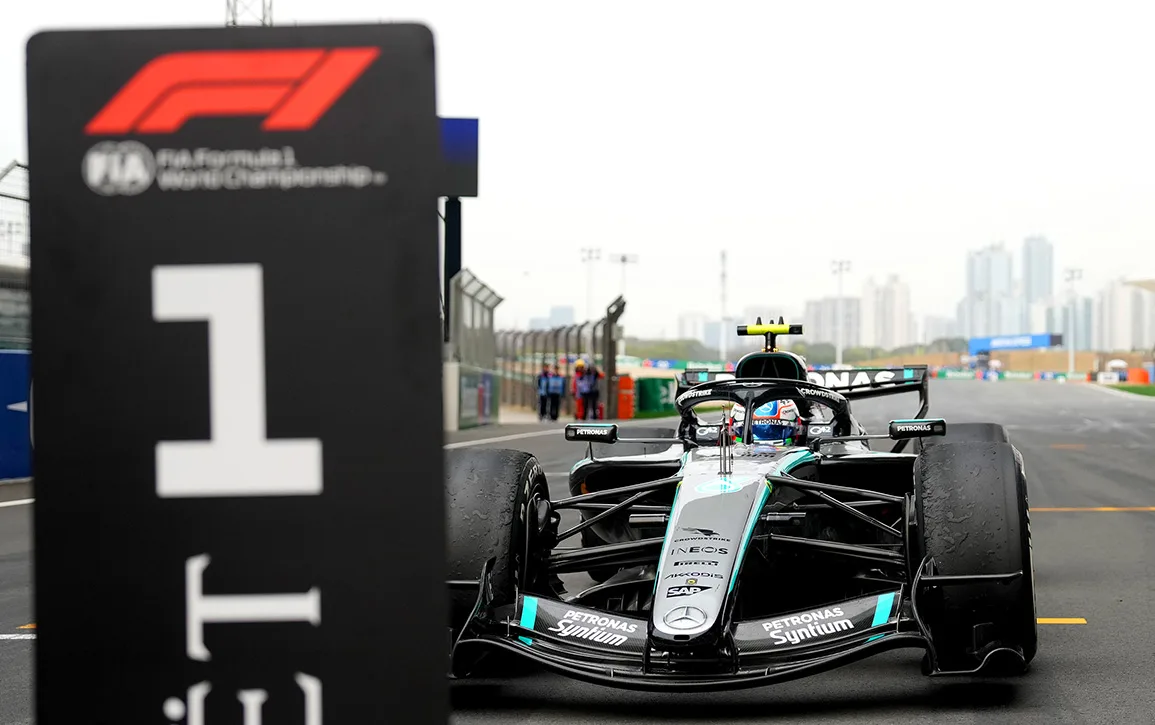

The China Grand Prix did not overturn the early story of the 2026 season. It sharpened it. George Russell entered Shanghai leading the Drivers’ Championship. This was after his victory in Australia. Already, Mercedes look like the most comfortable team under the new regulations. Kimi Antonelli, in the other Mercedes, was trailing Russell but was not far off his pace. Ferrari had shown speed but not control. Red Bull had shown flashes but little consistency. McLaren had barely started the season at all. China did not simplify those dynamics. If anything, it made them harder to ignore.
The weekend belonged to Kimi Antonelli. The Mercedes driver secured pole position with a 1:32.064 and later set the fastest lap of the race, converting that advantage into his maiden Grand Prix victory. For a driver only in his second full season, it was the sort of performance that makes the ‘future star’ label feel outdated.

Antonelli controlled the race from the front and survived a late push from his teammate George Russell to claim the win. It was the first Formula 1 victory by an Italian driver since Giancarlo Fisichella at the 2006 Malaysian Grand Prix.
Russell followed him home to complete another Mercedes one-two finish, reinforcing the sense that the team has understood the early phase of this regulation cycle better than its rivals. Mercedes had arrived in Shanghai looking like the early benchmark under the new regulations. Two races into the season, that impression looks even stronger.
Behind them, Ferrari spent most of the race confirming both its strengths and its frustrations. The car had pace. But control of the race never quite shifted their way. Mercedes dictated the tempo while Ferrari remained close enough to compete without ever truly threatening the lead. Hamilton ultimately secured 3rd after a long duel with Leclerc for the final podium place, giving Hamilton his first podium finish in a full Grand Prix since finishing 2nd for Mercedes at the 2024 Las Vegas Grand Prix.

It was a solid result, but it also reinforced the same pattern that had appeared in Australia. Ferrari looks fast enough to compete. It just hasn’t yet looked fast enough to control a race.
Elsewhere, the race was shaped by events that happened before it had even properly begun. Both McLarens failed to start after encountering power unit problems before the formation lap. The double non-start was particularly painful for the team, given that the weekend marked McLaren’s 1,000th Formula 1 entry.
Audi’s Gabriel Bortoleto did not start because of hydraulic issues. Alexander Albon’s Williams faced similar problems. This left the grid noticeably thinner before the lights even went out.
Red Bull’s afternoon followed a different kind of frustration. Max Verstappen qualified 8th and spent much of the race running inside the points before retiring on lap 45 with a gearbox failure. For a team accustomed to dictating the championship’s rhythm, the opening races of 2026 have instead become exercises in damage limitation.
Behind the leading teams, the midfield continued to reshape itself. Oliver Bearman delivered another strong drive for Haas to finish 5th, confirming the team’s ability to consistently collect points in the early races. Pierre Gasly brought Alpine home 6th, while Liam Lawson and Isack Hadjar scored for Racing Bulls. Carlos Sainz salvaged two points for Williams in 9th, and Franco Colapinto completed the top 10 for Alpine.
Cadillac’s learning curve continued quietly in the background. Sergio Pérez finished 15th while teammate Valtteri Bottas crossed the line a lap down in 13th. For a new team still establishing its operational rhythm, finishing races remains the more realistic objective than fighting for points.
Looking back at the expectations before the race, several of the early predictions held. Mercedes remained the team to beat, even if it was Antonelli rather than Russell who ultimately delivered the victory. Ferrari again qualified near the front and stayed competitive throughout the race, but once more lacked the pace to dictate it. The prediction that Verstappen might drag Red Bull back into contention did not survive the race distance, while the expectation of a tight midfield battle proved accurate.

Two races into the season, the outline of the championship is beginning to form. Russell still leads the Drivers’ Championship with 51 points, but Antonelli now sits only 4 points behind after claiming his first Grand Prix victory. Mercedes leads the Constructors’ standings with growing authority, while Ferrari remains close enough to challenge but not yet close enough to control.
The season is still young. But if Shanghai confirmed anything, it is that Mercedes may already understand this new era better than anyone else.
Featured image credit: mercedesamgf1.com
Edited by Alexandra.
About The Author


Leave a Reply