

They are not on the grid. Their names do not appear on the entry lists. But the women in F1 2026 are shaping the outcomes of races, building the cars that make the headlines, and quietly dismantling a culture that spent decades telling them they did not belong here.
Formula One has always been defined by firsts – first pole, first win, first championship. But the firsts being written by women across the paddock right now carry a different kind of weight. They are not one-off moments. They are the beginning of a new normal.
From the pit wall to the wind tunnel, from the podium step to the press room, we spotlight one woman from eight teams – each a different department, each a living, working argument that the sport is on its way to changing where it matters.
Red Bull Racing – Hannah Schmitz | Head of Race Strategy
A moment from the 2022 Hungarian Grand Prix that tells you everything you need to know about Hannah Schmitz. Max Verstappen was tenth on the grid, Charles Leclerc was leading comfortably and the received wisdom said this race was already decided.

Schmitz disagreed. She sent Verstappen out on soft tyres – an aggressive, unconventional call that the rest of the pit wall had not seen coming. He won. Verstappen, never a man who offered compliments lightly, called her “insanely calm.”
That calmness is Schmitz’s defining quality, and it has been earning its keep at Red Bull since 2009, when she walked out of Cambridge University with a master’s degree in mechanical engineering and straight into an internship at Milton Keynes.
She rose to Senior Strategy Engineer in 2011 and Principal Strategy Engineer in 2021 – the year she helped Verstappen to his first world title – before being promoted to Head of Race Strategy at the start of 2026, following Will Courtenay’s departure to McLaren.
She now leads the entire department through F1’s most sweeping technical revolution in years, with new power units and active aerodynamics fundamentally reshaping the strategic landscape she has spent sixteen years mastering.
One of only 13 women in history to stand on the F1 podium, Schmitz is one of the most influential women in F1 2026 at a team navigating both a regulation reset and a new team principal in Laurent Mekies.
Racing Bulls – Alexandra Horton | Head of Communications
On 8 March 2026 – International Women’s Day, and the morning of the Australian Grand Prix – Alexandra Horton stood in the Melbourne paddock alongside two other women being recognised for their contributions to the sport.

She described it as “a career highlight” and “a huge honour to stand alongside two inspirational leaders on a historic day.” It was a moment that summed up both the progress being made and the person at the centre of it: someone doing the work quietly, and being recognised for it loudly.
Horton is the Head of Communications at Racing Bulls – the Faenza-based team that has grown from Red Bull’s junior outfit into a genuine constructor in its own right. It is a role that demands total command of the team’s voice, internally and externally, across media and across borders, at a time when Racing Bulls’ identity and ambitions are evolving faster than at any point in their history.
Her work in the lead-up to the 2026 season – partnership announcements with Indeed and Peloton, fan experience initiatives designed to bring F1 to new and undeserved audiences – reveals someone deeply invested in widening the sport’s reach.
Communication in F1 is not a soft role. It is the department that shapes how the world understands a team. At Racing Bulls, that job belongs to Horton.
Haas F1 Team – Laura Müller | Race Engineer
The race engineer is the closest thing F1 has to a co-pilot. They are the voice in a driver’s ear, the person who turns data into real-time decisions, the human link between the garage and the cockpit when everything is moving at 200 miles per hour.

In January 2025, Haas announced that Laura Müller would be taking on that role for Esteban Ocon – and in doing so became the first woman to hold the position of race engineer full-time in the history of the sport.
Müller’s path to that seat was hard-won. Growing up near Lake Constance in Germany, she studied automotive engineering at the Technical University of Munich before working her way through Formula Renault, Stock Car Brazil and DTM – where she engineered Sophia Flörsh at Abt Sportsline – before joining Haas in 2022 in the simulator department.
She was promoted to performance engineer in 2024, then to race engineer the following January. Team Principal Ayao Komatsu did not choose her as a statement. He chose her because, as he put it, “when she finds the first solution, she knows there are ten more questions to answer.”
She enters 2026, her second season in the role, with a full year of live race engineering behind her and a corner named after her at Melbourne’s Albert Park. History has a way of being heavy. Müller carries it lightly.
Mercedes – Amy Walker | Trackside Operations Engineer
On 4 May 2026, Kimi Antonelli climbed to the top step of the Miami Grand Prix podium and was joined there by a woman who had been quietly integral to his race weekend from the moment the team touched down in Florida.

Amy Walker, Trackside Operations Engineer at Mercedes, became the thirteenth woman in F1 history to stand on an F1 podium, a number that sounds significant until one realises how many decades it took to reach it.
Walker has been with Mercedes since January 2016, progressing through roles as a Powertrain Dyno Test Engineer and Senior Dyno Test Engineer before settling into her trackside operations position.
Her work at race weekends sits at the intersection of engineering rigour and real-time problem-solving – the kind of role that wins nothing when it does everything right and loses everything with a single error. She came up through Ricardo, where she worked in driveline and transmission testing, and brought that precision with her to Brackley.
The Miami podium was recognition, long overdue, for a decade of work done in service of a team that was defined a generation of F1. Walker stood up there and made history.
McLaren Racing – Lou McEwen | Chief Marketing Officer
When Oscar Piastri won the 2025 Miami Grand Prix, the woman standing on the podium alongside in papaya orange was Lou McEwen – the second female representative from McLaren to stand on an F1 rostrum, and the Chief Marketing Officer who has helped transform the team into the sport’s most culturally electric brand.

McEwen joined McLaren as a consultant in 2014, spending ten years building her way through the organisation before being appointed CMO in May 2024. The timing was not incidental. McLaren’s back-to-back constructors’ championships in 2024 and 2025, and Norris’ drivers’ title last season, have coincided with a commercial and cultural explosion for a team that had spent years in mid-table obscurity.
That papaya resurgence – the merchandise, the collaborations, the social presence that has made McLaren a global lifestyle phenomenon as much as a racing team – does not happen by accident. It happens with strategy, storytelling, and someone who understands both the sport and the generation now watching it.
In a sport where commercial value increasingly determines everything from driver contracts to infrastructure investment, McEwen’s work is not peripheral. It is foundational.
Scuderia Ferrari – Angela Cullen | Performance Physiotherapist
Angela Cullen is not a Ferrari employee in the traditional sense. She is the woman Lewis Hamilton trusted to keep him at the physical and mental peak required to win seven world championships – and when he moved to Maranello for 2025, she came with him.
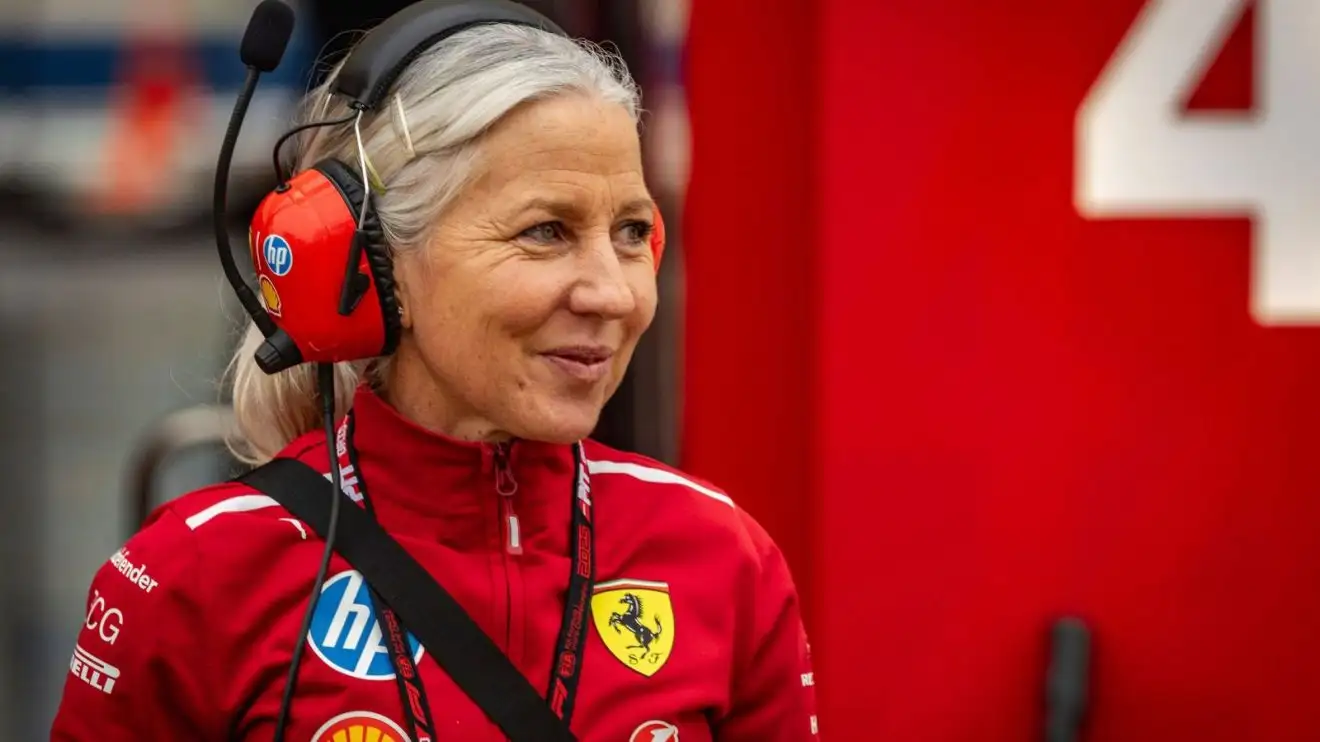
A New Zealand physiotherapist and former international field hockey player, Cullen spent eight years alongside Hamilton a Mercedes from 2015 to 2023, becoming one of the most recognised figures in the paddock.
Their working relationship extended far beyond physiology. She managed his preparation, his recovery and his daily rhythm across a race weekend. When they parted ways in early 2023, Hamilton’s form noticeably suffered.
By the time he arrived at Ferrari, the reunion was already being discussed in paddock circles. A photo of Cullen in a red race suit, posted to Instagram just before Hamilton’s first Fiorano test, confirmed what insiders already suspected.
She holds a degree in health science and physiotherapy and earlier in her career worked with British Olympic athletes, including the 4x100m relay team that won gold at the 2004 Athens Games.
In 2026, with Hamilton finding his feet in red and Ferrari pressing hard on the new regulations, Cullen is once again the constant behind his consistency.
Williams Racing – Christina Sullivan | Wind Tunnel Electronics and Systems Engineer
Christina Sullivan never planned to work in F1. She was studying mechatronics engineering at the University of Waterloo in Canada during the pandemic, contemplating a career in special effects for filmmaking, when her sister convinced her to watch Drive to Survive.

What followed is the kind of origin story that makes the women in F1 2026 so compelling – not a single dramatic leap, but a series of determined steps.
Sullivan applied for an industrial placement at Williams, secured it, and spent a year working in the Aero Test Facilities team. She returned to Canada to finish her degree, graduated in 2023 and was offered a full-time position at Grove as a Wind Tunnel Electronics and Systems Engineer.
Her work is precise and unglamorous and completely vital: designing and fabricating the electrical systems within the wind tunnel model, developing data acquisition systems, and ensuring that every aerodynamic reading taken in that facility is accurate enough to translate into real gains on the car.
“All the aerodynamic developments that are seen on the car during races are first seen on this model in the wind tunnel,” she has said. In a year defined by sweeping regulation changes, the quality of that data pipeline has never mattered more. Sullivan sits at the very start of it.
She has spoken openly about what it means to navigate a male-dominated engineering environment, crediting her mother, Dr. Pearl Sullivan, former Dean of Engineering at Waterloo, and her sister with teacher her to advocate for herself early.
Those lessons, she says, are “big hurdles when you are a younger female engineer.” She clears them every day.
Alpine F1 Team – Kate Goldup | Lead Aerodynamicist
Alpine’s 2026 season has been defined by change. A new power unit, new management under Flavio Briatore and a year of deliberate sacrifice in 2025 to redirect resources toward the regulation reset.

In the middle of all that upheaval, in the Enstone factory that has housed championship-winning teams under every name it has ever carried, Kate Goldup has been doing what aerodynamicists do: making the car faster.
Goldup is Lead Aerodynamicist at Alpine – one of the most senior women in the technical department of any F1 team. She was highlighted during International Women in Engineering Day in June 2025 as a visible role model within the Enstone facility, speaking about the growing number of female colleagues around her and the importance of that visibility for those coming after.
Alpine’s Rac(H)er programme, launched in 2022 with a stated target of reaching 30% female engineers by 2027, has been one of the most structured diversity commitments in the paddock. Goldup is not a product of that programme – she was there before it – but she is precisely the kind of visible, credential-led, senior woman it was designed to produce more of.
In an aerodynamics department that will be fundamental to whether Alpine can climb back toward the front of the grid under the new regulations, her fingerprints are on the car.
The bigger picture
F1 in 2026 is a sport in the middle of a technical revolution. New engines, new aerodynamics and a new team. But the most meaningful shift in the paddock is not written into any regulation document. It is in the accumulation of women in rooms where they were once told they did not belong.
The women in F1 2026 are not anomalies. They are the new standard.
Feature Image: F1 Media
About The Author


Leave a Reply