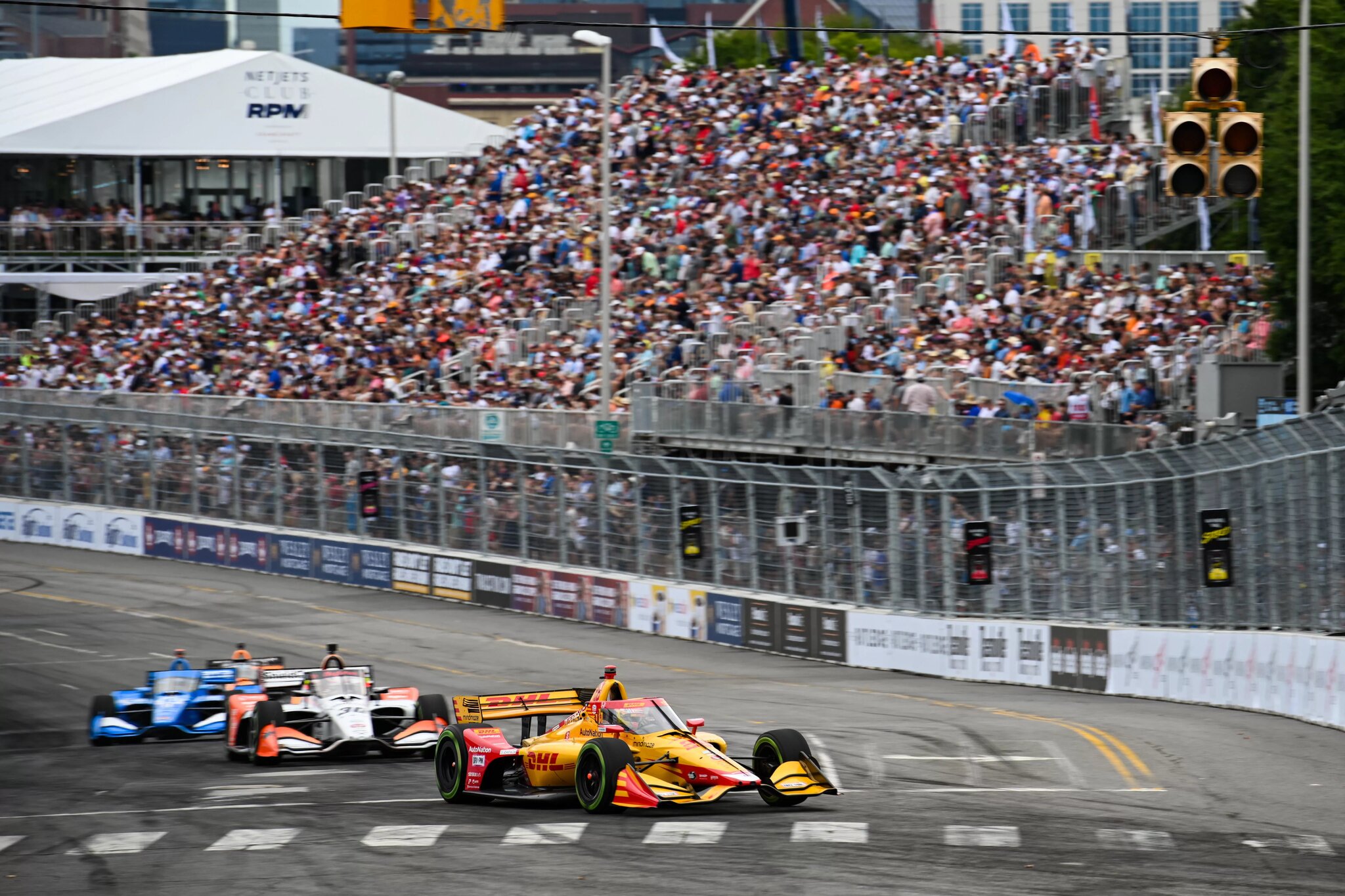

If you are new to INDYCAR, you probably heard the words “Push to Pass” everywhere during the Long Beach controversy and immediately wondered what everybody was talking about.
The system became one of the biggest talking points in the paddock after a software failure created confusion for drivers, officials, and fans alike. Before breaking down the controversy, it is important to explain what Push to Pass actually is and how it works in INDYCAR.
What Is Push to Pass in INDYCAR?
Push to Pass is INDYCAR’s driver-controlled temporary horsepower boost system used on all road and street courses. Drivers activate Push to Pass by pressing a button on the steering wheel. Once activated, the system delivers around 50 to 60 extra horsepower for a short amount of time.
The extra power helps drivers:
- Overtake competitors
- Defend position
- Exit corners faster
- Attack during restarts
- Create gaps during pit stop strategies
Unlike Formula 1’s DRS system, Push to Pass can normally be used almost anywhere on the circuit once it becomes available. Push to Pass is not used during oval races. The system is exclusive to road and street circuits because those tracks create more braking zones and overtaking opportunities.
How Does Push to Pass Work?
Each INDYCAR driver receives a limited amount of Push to Pass time during a race. Drivers must manage their usage carefully because every activation matters. Teams often save extra Push to Pass time for late-race battles and restart situations.
Different tracks also use different activation lengths:
- Some races allow 15-second activations
- Others allow 20-second activations
Once a driver uses all of their Push to Pass time, they cannot activate the system again during the race.
Before the Long Beach controversy, INDYCAR also had strict rules about when drivers could not use Push to Pass:
- Not at the race start
- Not immediately after restarts
- Only after crossing the alternate start-finish line under green flag conditions
At least, that was how the system was supposed to work. Then Long Beach happened.
Link to what push to pass is explained by FOX: FOX Sports
What Happened During the Long Beach Push to Pass Controversy?
During the closing laps of the Long Beach race, INDYCAR experienced a Push to Pass software malfunction during a restart sequence. The software failure accidentally allowed drivers to use Push to Pass when the system should have been disabled.
And honestly, the entire situation sounded like something straight out of a tech support nightmare. According to INDYCAR’s official investigation, simultaneous CAN (Controller Area Network) messages were mistakenly sent to multiple cars at the same time.
Normally, the system sends individual signals to each car. Those signals include:
- Position data
- Gap information
- Lap count
- Push to Pass availability
Instead, multiple signals were triggered at once. That caused the Push to Pass shutdown sequence to fail.
As a result:
- Push to Pass stayed active during the caution
- Push to Pass remained active during the restart
- Some drivers realised the system was available
- Some drivers used it
- Other drivers had absolutely no idea it was active
INDYCAR later confirmed the problem was caused entirely by the series software, not by teams or drivers. That is when the controversy exploded.
Link to Long Beach push to pass incident: IndyCar
Which INDYCAR Drivers Used Push to Pass?
INDYCAR confirmed that 12 cars activated Push to Pass during the software malfunction.
| Car Number | Uses | Total Time |
|---|---|---|
| 3 | 1 | 3.0 sec |
| 6 | 3 | 8.0 sec |
| 8 | 2 | 12.1 sec |
| 10 | 3 | 15.1 sec |
| 12 | 1 | 6.0 sec |
| 14 | 2 | 7.0 sec |
| 15 | 1 | ~0.0 sec |
| 18 | 2 | 4.5 sec |
| 45 | 2 | 2.5 sec |
| 60 | 3 | 18.5 sec |
| 66 | 1 | 6.3 sec |
| 76 | 2 | 6.0 sec |

INDYCAR stated its analysis showed no major competitive advantage overall, although Car No. 66 did gain a position over Car No. 14 despite similar Push to Pass usage.
Officials ultimately decided not to change the race results because the malfunction originated from INDYCAR itself. Punishing drivers for a software issue they did not create would have caused another major controversy entirely.
INDYCAR Changes Push to Pass Rules for All Road and Street Races
Instead of simply fixing the software issue, INDYCAR decided to completely simplify the rules moving forward. Beginning at the Indianapolis Motor Speedway road course event, Push to Pass will now be available full-time after the alternate start-finish line on green flag laps. The new rule applies to every INDYCAR road course and street race for the rest of the season.
That means drivers no longer need to wait through complicated restart timing restrictions once the race goes green. After crossing the alternate start-finish line, drivers can immediately activate Push to Pass.
INDYCAR introduced the change to:
- Reduce confusion
- Simplify enforcement
- Improve officiating consistency
- Increase overtaking opportunities
- Prevent future software-related controversies
And honestly? This is probably the right move. The previous rules created far too much grey area once software problems entered the picture.
Link to IndyCar expanding push to pass: IndyCar
INDYCAR Drivers Were Completely Confused
The most revealing part of the entire controversy came during the post-race media session. Because it quickly became obvious that even the drivers were not completely sure how the rules were supposed to work anymore. Alex Palou was stunned by the idea that drivers could potentially be penalised for using a system INDYCAR accidentally activated.
At one point, Palou responded:
“Someone in INDYCAR messed up and it’s my fault?”
That quote basically summed up the reaction across the paddock. Palou also admitted he used Push to Pass three times and was surprised more drivers did not use it.
Meanwhile, Kyle Kirkwood said what many drivers were probably thinking:
“Everybody would have used it if they’d known it was active.”
And honestly, he is probably right. If drivers knew they suddenly had extra horsepower available during a restart, almost the entire field would have pressed the button immediately. Then the conversation somehow became even more chaotic.
Pato O’Ward pointed out the biggest issue with the old wording of the rule:
“It’s not explicit the drivers cannot use it if the software allows.”
That single sentence perfectly explained the confusion.
Drivers were left wondering:
- If the software activates Push to Pass
- And the button works
- Are drivers actually supposed to ignore it?
Nobody seemed fully certain. Even David Malukas joined the debate as drivers tried to figure out which version of the rule everyone was discussing. At one point, Kirkwood joked:
“We should probably move the drivers meeting up to now.”
Honestly, he was not wrong. The entire exchange felt less like a professional media session and more like a group project collapsing in real time.
Quotes: Penske Entertainment
Feature Image Credit: Last Wordon Sports
About The Author


Leave a Reply