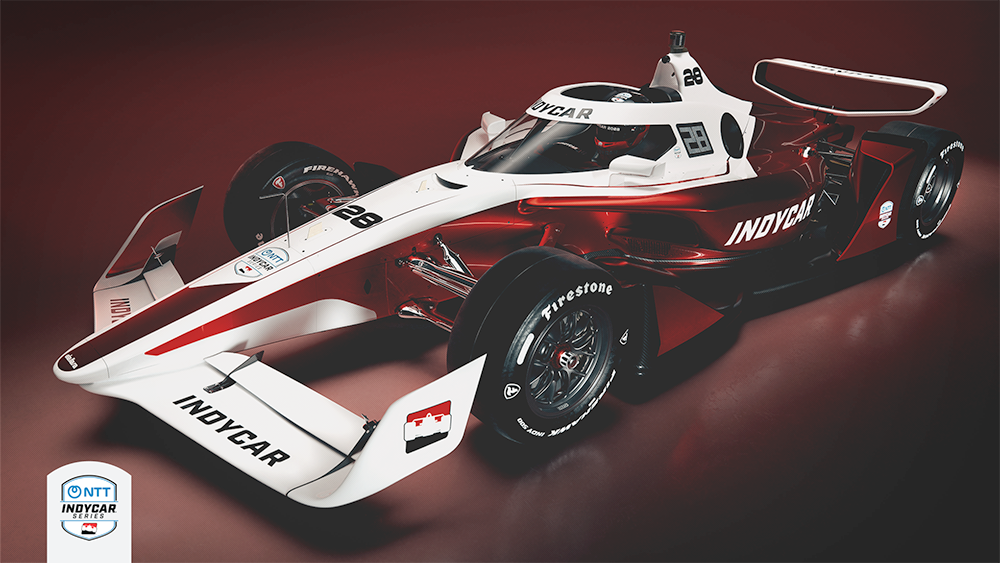

The NTT INDYCAR SERIES has officially unveiled the IR-28. The next-generation race car will debut at the start of the 2028 season, replacing the long-serving IR-18 chassis after a decade on the grid.
Developed by Dallara in collaboration with Chevrolet, Honda, Firestone, Shell and IndyCar, the IR-28 has been built with three key priorities: improving racing, increasing performance and continuing IndyCar’s commitment to safety.

Changes to the car
One of the biggest changes is a significant reduction in weight. The IR-28 is approximately 100 pounds lighter than the current chassis, while the battery-based hybrid system is around 20 pounds lighter than the existing unit. Combined with a lighter gearbox and improved aerodynamics, the new package is expected to produce faster lap times and could even threaten long-standing track records.
Power will continue to come from Chevrolet and Honda’s 2.4-litre twin-turbocharged V6 engines, now paired with a new hybrid system developed by BOLD Technology and Helix. Producing up to 760 horsepower, the battery stores around 14 times more energy than the current supercapacitor system. This allows drivers greater flexibility over how and when they deploy hybrid power during a race.

How the IR-28’s New Design Will Improve Racing
Visually, the IR-28 marks a major evolution while remaining unmistakably an IndyCar. Aggressive front and rear wings, sculpted bodywork and a cleaner integration of the aeroscreen give the car a modern appearance. Engineers have focused on reducing turbulent air, making it easier for drivers to follow closely and creating more overtaking opportunities.
The cockpit has also received several updates. The chassis is designed to accommodate a wider range of sizes, while electronic anti-roll bar controls replace the manual system. A new suspension package featuring the Custom AXIS Inertance Control System gives teams more setup possibilities throughout a race weekend.
A Safer, Smarter and More Modern IndyCar
Several new features include digital position displays and transparent engine-cover windows that showcase the powertrain beneath the bodywork. The redesigned chassis also provides additional space for sponsors, offering greater commercial opportunities for teams.
Safety remains at the heart of the IR-28’s design. The chassis features stronger side-impact protection, improved driver cooling and enhanced crash structures. Thins way,IndyCar continues to build on its already impressive safety record.
Drivers across the paddock have welcomed the arrival of the new car.
Reigning champion Álex Palou described the IR-28 as a natural evolution of the current INDYCAR. He praised how fresh its modern appearance looks, while still retaining the identity of the series. The Spaniard believes fans will embrace the new design and admitted he is eager to get behind the wheel when it makes its debut.
“The design is awesome and it feels like a natural step forward for the series while still looking like an IndyCar. I think the fans are going to love it, and as a driver, I can’t wait to get behind the wheel.”
Alexander Rossi highlighted the balance between innovation and safety. The new chassis delivers the modern look drivers hoped for without compromising the safety standards that have become a hallmark of the series.
“We all wanted a new, modern-day car that is lighter and looks futuristic and fast but still has all of the incredible safety advancements that IndyCar is known for.”
Marcus Ericsson said the aggressive styling immediately stood out, particularly the integration of the aeroscreen into the overall design. The 2022 Indianapolis 500 winner praised Dallara’s improvements throughout the car and admitted sitting in the cockpit made him want to drive it straight away.
“The car looks aggressive and raw, and I love the integration of the aeroscreen with the rest of the chassis. Dallara has improved so many areas both inside and out. I jumped in and quickly got the urge to take it for a spin. I wish we could go sooner than 2028.”
Will Power praised both the design and engineering of the new INDYCAR chassis. He agreed saying it strikes the perfect balance between performance, safety and modern styling. After seeing the exterior and cockpit, the two-time series champion believes the car represents a significant step forward.
“I was just as excited to see what was inside the car as I was to see what it looks like on the outside. INDYCAR and Dallara have done an incredible job combining updated aerodynamic ideas with all of the safety elements from the current car. It has a seamless look and one that’s also modern and aggressive at the same time.”
Arrow McLaren Team Principal Tony Kanaan admitted the unveiling reignited his desire to get behind the wheel. The 2013 Indianapolis 500 winner highlighted the car’s futuristic appearance, expected performance gains and the extensive safety improvements.
“What a sight. I sat in the car and, in the past three years, I haven’t had the itch to drive again as much as I did sitting in it. The car looks beautiful, futuristic and very impressive. Aerodynamically, it looks a lot quicker – and if it looks quicker, it’s going to be quicker. The safety considerations are a key aspect and well thought out, as well. Thank you, INDYCAR and Dallara. I can’t wait, and I’m excited about the future.”
Team Penske’s Scott McLaughlin also welcomed the new design, describing it as a refined evolution that preserves the identity of an INDYCAR while introducing new technology. He praised the attention to detail throughout the car and believes it raises the standard for the series.
“It’s awesome. It just looks racy. It has a really good design. It’s refined, very well thought through and filled with details both inside the cockpit and out. Plus, it’s kept the core INDYCAR feel while expanding our technology and taking this to another level. I’m really excited.”
Chip Ganassi Racing’s Kyffin Simpson believes the new car has exceeded expectations and expects its performance to improve the quality of racing even further. He also looks forward to hearing the new 2.4-litre engine in action and sees the package as another major step in the evolution of the NTT INDYCAR SERIES.
“I’m really excited – it has exceeded expectations. I’m also super excited about the performance expectations, which sound very promising and will add to the great racing that we already have. I cannot wait to see it out on the track and hear the 2.4-liter engine, as well. This will take INDYCAR to the next level.”
Testing Begins Ahead of the IR-28’s 2028 Debut
Testing is already underway at Indianapolis Motor Speedway and Sebring, giving teams almost two years to understand and develop the new package before its competitive debut in 2028.
After ten successful seasons with the IR-18, the IR-28 signals the beginning of an exciting new chapter. With more power, reduced weight, improved safety and a striking new design, IndyCar is aiming to deliver an even better spectacle for drivers and fans alike when the green flag falls in 2028.
Feature image credit: IndyCar
Edited by Francesca.
About The Author


Leave a Reply