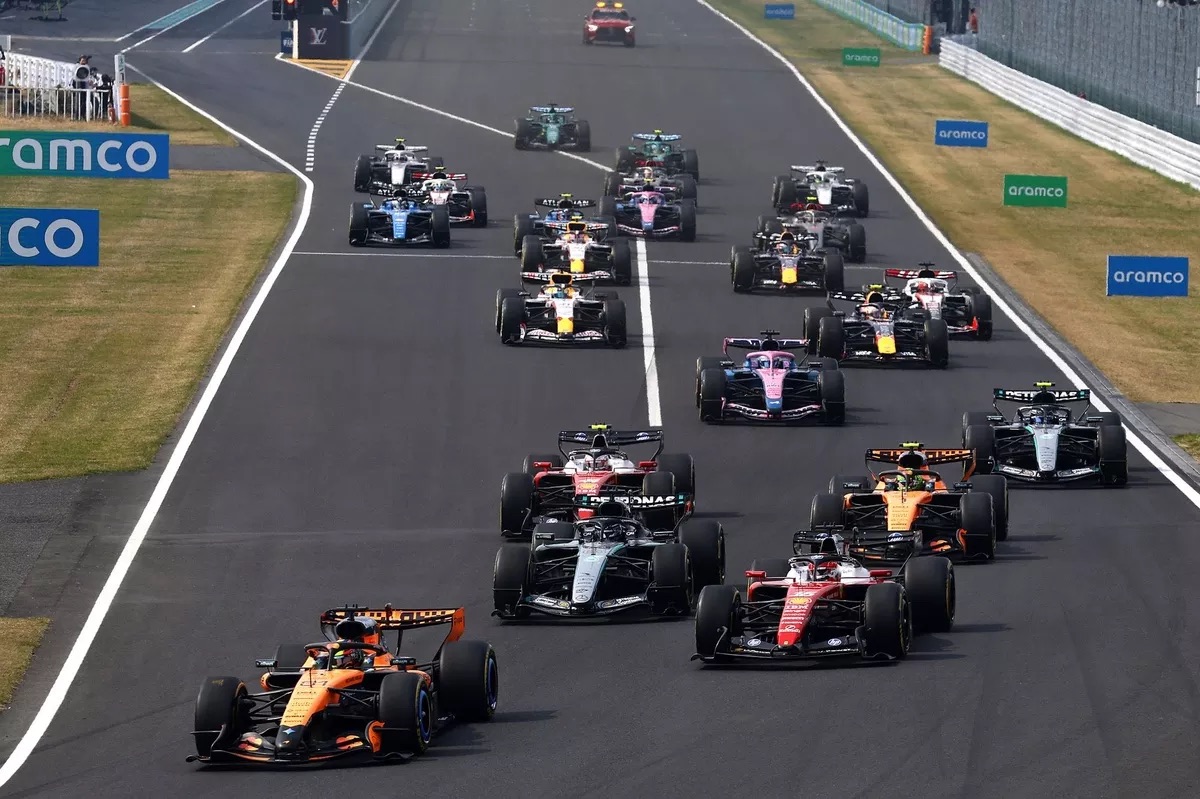

The Formula 1 2026 season has arrived as a violent collision of technical ambition and generational transition. With the sport pivoting to a radical 50/50 power split between the internal combustion engine and electric recovery, the hierarchy of the grid has been torn apart and rebuilt in the opening flyaway rounds.
Five races into this engineering reset, the patterns of dominance and decline can already be seen in the races from Melbourne to Suzuka.
Winner of F1 2026 season: Mercedes
The team to follow during this 2026 season has emerged to be Mercedes. They have weaponised the new regulations and reclaimed their place at the summit after years of Red Bull and McLaren dominance.

The W17 chassis appears to have mastered the complex active aerodynamics and energy management requirements. This has allowed George Russell and Kimi Antonelli to manipulate drag levels with a precision their rivals lack.
While Russell entered the year as the de factor leader, it is the 19-year-old sensation Antonelli who has stolen the narrative. Leading the World Championship with 97 points, his ability to manage the manual override, the high-stakes energy boost that replaced Drag Reduction System, under pressure has been clinical.
His victory in Japan was a statement. The Silver Arrows have cracked the code of the 350kW ERS system.
Loser of F1 2026 season: McLaren
In an unexpected reversal of fortune, the reigning Constructors’ Champions have become the biggest shock of the F1 2026 season transition. Despite Lando Norris entered the year as the defending Drivers’ Champion, the MCL40 has been a shadow of its predecessor.

The car is plagued by a significant grip deficit and a shaky start that has left the team fighting for scraps in the lower points positions. The technical reality hit home in China with a disastrous double DNS for Norris and Oscar Piastri.
Both cars were sidelined by catastrophic power unit management issues, highlighting a team struggling to grasp the complexities of the new Mercedes HPP integration. Despite the team being dominating in 2025, the fall out of the top teams have been a bitter blow.
Winner: Ferrari
Ferrari has indeed found itself as a solid winner in terms of development, currently occupying second in the championship standings. Charles Leclerc has been their standout performer. He has secured 64 points and a hard-fought podium in Suzuka through sheer tenacity.

Despite the SF-26 lacking the raw efficiency of the Mercedes in high-speed deployment, the team has successfully integrated Lewis Hamilton into the fold. Hamilton’s second year in red has seen him provide the steady hand needed. The early-season reliability gremlins have plagued other manufacturers. This is where Hamilton’s experience comes in handy.
Ferrari remains the only team capable of beating Mercedes in a straight fight on pure mechanical grip. Despite this, the team are hunting for that final tenth of electrical efficiency.
Loser: Red Bull
The most jarring shift of the F1 2026 season is the slump of Red Bull Racing. The team has been stripped of the technical genius of Adrian Newey and the operational stability of Jonathan Wheatley. The team has struggled to adapt to its maiden in-house power unit.

Max Verstappen, once the undisputed king of the grid, currently languishes in ninth in the standings. Overall in the season, he only has 16 points. The RB22 has been hampered by chronic deployment issues. One of the many problems of the new Red Bull car has been “clipping” and running out of electrical energy halfway down the long straight of Shanghai.
Without the “Newey-magic” to mask these power deficits with aero efficiency, the Milton Keynes squad looks remarkably vulnerable.
Winner: Pierre Gasly
Pierre Gasly has made a remarkable resurgence for Alpine. Following a dismal 2025 that saw the team slip toward the back of the grid, the strategic shift to become a Mercedes power unit customer has proven to be a masterstroke.

Gasly sits currently at eighth in the standings with 21 points. He has declared that the team is now in a “different league” during this F1 2026 season. His performance in China was a masterclass in defensive driving. He held off faster cars and Verstappen for full stints and consistently found himself in the top ten.
This gritty, points-scoring consistency has revitalised a French team that many analysts had written off during the regulation transition.
Loser: Aston Martin
Despite the transition to Honda power and the influence of Newey’s early 2026 concepts, the team has failed to score a single point in the opening rounds. Fernando Alonso and Lance Stroll find themselves trapped at the back of a hyper-competitive midfield.

The team are struggling with a chassis that seems inherently incompatible with the new active aero mandates. The AMR26 has shown a tendency to become unstable when the wings stall for drag reduction.
This leaves the drivers with zero confidence in high-speed corners. For a team that invested so heavily in infrastructure, sitting last in the Constructors’ standings is a catastrophic start to the new era.
Winner: Gabriel Bortoleto
Audi’s entry into F1 has been validated by the precocious talent of Gabriel Bortoleto. The Brazilian driver secured points on Audi’s debut in Melbourne with a P9 finish. This was followed by a brilliant qualifying performance in Japan to reach Q3.

His ability to handle the steep learning curve of the new power units has seen him consistently outshine his veteran teammate, Nico Hülkenberg. Bortoleto represents the new generation of drivers who have grown up with hybrid complexity, making him the perfect figurehead for Audi’s ambitious works project.
Loser: Cadillac
The Cadillac F1 team did not live up to the expectations they created. While the team deserves credit for being respectable and staying within 5% of the leaders’ pace, Sergio Perez and Valtteri Bottas are struggling with the harsh realities of a new entry.

They remain point-less after five rounds, with Perez calling for a big upgrade in Miami to address a severe lack of downforce. The team is currently in a pivotal moment. They are discovering that in the F1 2026 season, being “okay” is equivalent to being last.
Winner: Oliver Bearman
Oliver Bearman has planted himself as the “best of the rest”. Driving for Haas, the young driver scored 17 of the team’s 18 points so far.

His top-five finish in China was a revelation. It showcased a driver who can manage tyre thermal degradation while simultaneously juggling complex energy harvesting maps.
Despite the 50G crash at Suzuka, he has effectively carried the team into its most successful season start in history. This only proves that he belongs at the very front of the grid.
Loser: Williams
Despite the optimism surrounding their “bold” design choices for the F1 2026 season, Williams have emerged as a significant loser in the initial development race.
Alex Albon and Carlos Sainz have been vocal about the car’s fundamental lack of straight-line efficiency. This has been a historical strength that has vanished under the new active aero regulations.

The FW48 appears to suffer from excessive drag when the wings are in their high-downforce configuration. Yet, it lacks the rear-end stability required for the twisty sectors of Albert Park and Suzuka.
As the paddock prepares for the Miami heat, the F1 2026 season remains a volatile laboratory of speed. In this new era, where a single software tweak to energy deployment can redefine the pecking order, no lead is safe and no deficit is permanent.
Feature image: Purple Sector Press
Edited by Alexandra.
About The Author


Leave a Reply