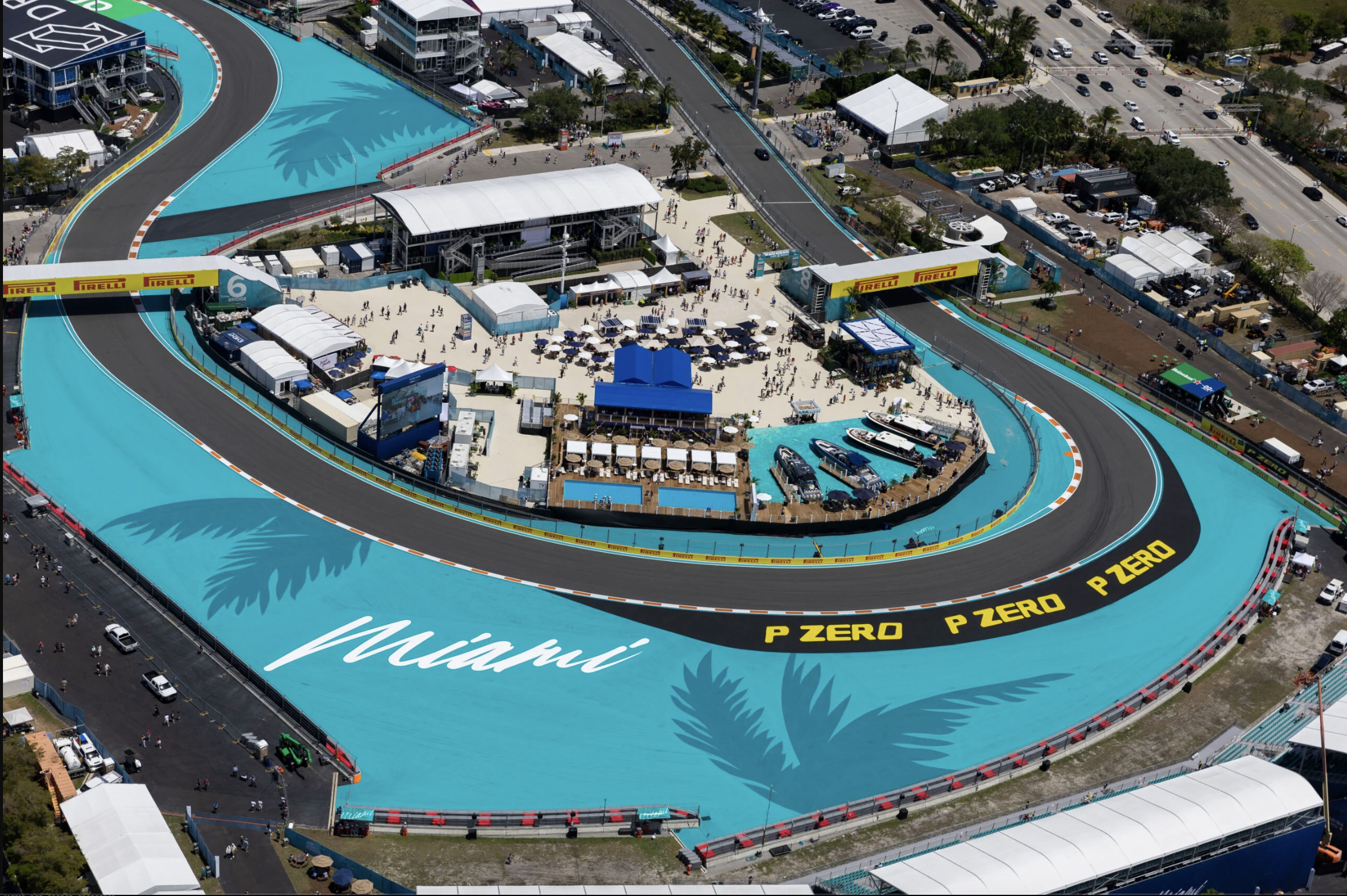

Formula One roars back to life at the Miami International Autodrome this weekend for what promises to be the most consequential race of the early 2026 season. After a five-week hiatus forced by the cancellation of the Bahrain and Saudi Arabian rounds, teams and drivers are finally set to return to the track, carrying a bundle of mid-season regulation tweaks, a raft of development upgrades, and a championship picture that is at once thrilling and unexpected as they walk into the Hard Rock Stadium.
Kimi Antonelli leads the drivers’ standings heading into Round 4 – a sentence that would have been nearly unthinkable this time twelve months ago. The 19-year-old Mercedes prodigy has delivered back-to-back victories in China and Japan, arriving in Florida nine points clear of teammate George Russell. Ferrari’s Charles Leclerc is at a further distance behind in third, and four-time World Champion Max Verstappen sits a distant ninth with just 12 points.
But the 2026 Miami Grand Prix is about more than just the championship standings. The FIA has confirmed that a package of regulatory adjustments has been specifically timed to come into force this weekend. The sport’s governing body has responded to criticism from drivers, fans and engineers alike about certain characteristics of the new 2026 regulations.
The 2026 regulation tweaks
Following a series of stakeholder meetings involving the FIA, team principals, power unit manufacturers and drivers, a package of mid-season adjustments has been confirmed for implementation from the 2026 Miami Grand Prix.
The changes are targeted, rather than sweeping, and respond to specific issues that emerged across the opening three rounds in Australia, China and Japan.
The headline adjustment concerns energy management. The ‘super clipping’ power limit has been raised from 250kW to 350 kW. Alongside this, the qualifying harvesting limit has been reduced from 8MJ to 7MJ.
In practical terms, the speed fluctuations on the straights that have made the 2026 cars look erratic should be shorter in duration and more predictable in profile. The FIA expects super-clip periods to last no longer than two to four seconds per lap.
A visual warning system has also been introduced. The cars running under reduced energy or emergency modes will now activate flashing rear and lateral lights. This is done to alert the following drivers. Oliver Bearman’s 50G crash at Suzuka led to this change, with high closing speeds identified as a big contributing factor. The Haas driver has since recovered, and is fit to race at the Miami Grand Prix.
Race start procedures are also being addressed, with a ‘low power start’ detection system set to be trialled this weekend. If a car’s petrol-powered launch is dangerously weak in the opening moments, the system will automatically trigger a minimum level of MGU-K deployment. This change will be formally adopted for the remainder of the season, depending on the analysis of the data gathered.
The 2026 Miami Grand Prix circuit

The Miami International Autodrome sits within the Hard Rock Stadium complex in Miami Gardens, Florida, home to the NFL’s Miami Dolphins franchise. It was designed by Apex Circuit Design and built to permanent construction standards, despite being a temporary layout. The circuit made its F1 debut in 2022 and has been a fixture on the calendar since then. F1 has also announced a 10-year contract extension with Miami on top of its existing deal, securing the race at the venue until 2041.
The circuit measures 5.412 kilometers across 19 corners and runs in an anti-clockwise direction, with three long straights giving cars the perfect opportunity to reach speeds in excess of 320 km/h. Overtaking is most viable in Turn 11 and Turn 17 at the end of the straight runs.
The lap also features a notable elevation change between Turns 13 and 16, where the track traverses an exit ramp and undulates beneath several flyovers – a section that rewards mechanical confidence and punishes mistakes given how close the barriers are throughout.
Miami also has a habit of producing race craft over raw pace. No pole-sitter has converted their grid position into a race win across any of the circuit’s previous four editions, a statistical quirk worth noting as we go into the weekend.
Miami is one of the six sprint weekends on the 2026 calendar. Teams get a single 90-minute practice session on Friday, before going straight into sprint qualifying. Saturday covers the sprint race itself, and then full qualifying for Sunday’s F1 Grand Prix.
With almost no free data, setup calls are made on limited information, historically producing some of the more unpredictable sprint results of the season.
Looking ahead
As the 2026 Miami Grand Prix approaches, all eyes will be set on the Silver Arrows as the championship leaders in the Drivers’ as well as the Constructors’. Can Kimi Antonelli win his third race in a row, or will George Russell take the trophy? And where does Ferrari play into this?
Featured image: corp.formula1.com
Edited by Reo Lane.
About The Author

Leave a Reply