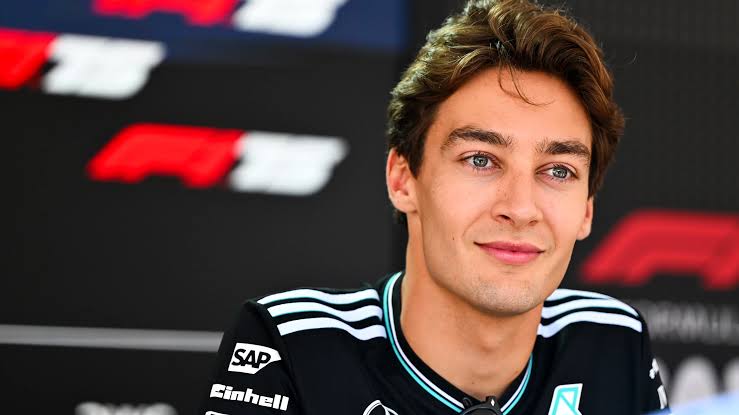

Picture a driver’s arms snapping out sideways, head dropped, frozen for a fraction of a second before the 2023 season opener broadcast even begins. That single frame from the title sequence was enough. The internet had already decided what George Russell would be for the next twelve months.
The memeification of George Russell that followed is still running today. Fans photoshopped him as a dinosaur’s jaw, as a front wing, and pretty much anything with two arms sticking out.
It’s funny. It’s also become the lens through which a large chunk of the sport views one of its most consequential voices. That’s worth picking apart.
Built by his own team: How the memeification of George Russell got a head start
The memeification of George Russell didn’t happen to Mercedes. It happened with Mercedes, quite deliberately. Lewis Hamilton spent his final seasons at Brackley doing relatively little personality-led content for the team’s own channels. Appearances were often earned through sponsors rather than in-house storytelling. His public persona also ran more toward fashion and activism than paddock comedy.
Russell filled that content gap almost by accident, and the team leaned into it hard once they saw what landed with audiences. The T-pose became the backbone of a whole meme series on Mercedes’ own accounts, including a widely praised video of Russell reacting to jokes made about him.
Other drivers noticed the pattern too. When asked which driver on the grid was most likely to go viral, Alex Albon didn’t hesitate, saying it’s “hard not to meme him.” By the time Kimi Antonelli arrived at Mercedes in 2025, the memeification of George Russell wasn’t a side effect of his personality – it was already the team’s house style, built up over several seasons with Hamilton doing comparatively little of that heavy lifting himself.
It doesn’t take official channels to keep it going, either. A stray introduction from a Mercedes video with Russell saying “Welcome to skibidi toilet Baku, my dudes,” has been looping through brainrot-style fan edits ever since, completely detached from any race context and purely along for the meme.
Whatever Russell is now, the team helped write the script long before anyone accused him of not being serious.
A teammate change hasn’t slowed it down
One would expect a new, younger teammate to shift some of that spotlight elsewhere, and in some ways it has – just not always in Russell’s favour. In June 2026, following the Barcelona-Catalunya Grand Prix, Mercedes’ own social channels posted a Barcelona debrief.
It framed Hamilton’s maiden win for Ferrari in warm, nostalgic terms as their “old friend” delivering a standout drive. It flagged Antonelli’s reliability-related DNF. However, it never once mentioned Russell. That’s despite the fact he’d started the race from pole, finished on the podium and was marking his 100th Grand Prix for the team that same weekend.
Fans noticed immediately, pointing out the oddity of naming a rival’s win and a teammate’s retirement while skipping the driver who actually delivered results. It wasn’t an isolated slip either; pundits and insiders have since questioned whether Mercedes’ content strategy has quietly tilted toward Antonelli as the more marketable story.
The memeification of George Russell, in other words, isn’t fading as the team’s roster changes. If anything, the pattern that built it in the first place – a driver doing the heavy lifting while the narrative goes elsewhere – looks remarkably familiar.
The serious job of George Russell
Russell has held a director’s seat at the Grand Prix Drivers’ Association since March 2021. He replaced the retiring Romain Grosjean, while still driving for Williams. After Sebastian Vettel’s retirement, Russell spent two years as the GPDA’s director before Carlos Sainz joined him in 2025.

In that time, he has pushed for consistency in how track limits are policed, and publicly pressed the FIA over the sudden removal of race director Niels Wittich late in the 2024 season. He challenged the size of fines handed to drivers for minor infractions – including one levied on Sainz for arriving late to the national anthem after a stomach issue. Russell wryly summed up as an “expensive poo” before immediately turning serious about the need for better collaboration between drivers and the governing body.
The pattern held again at the 2026 Monaco Grand Prix, when Russell radioed his team mid-race to ask, “What is going on in the last corner?” – flagging the exact patch of crumbling tarmac at Turn 19 that would trigger a red flag and two separate crashes barely ten laps later.
That’s the pattern with his advocacy: substantial concerns delivered with a punchline attached, feeding the memeification of George Russell even when the substance underneath is real.
When the memeification muffles a serious complaint
Nowhere was that clearer than at the 2025 Japanese Grand Prix. During a GPDA meeting at Suzuka, Russell raised a genuinely unglamorous but legitimate issue. Too few paddock toilets for twenty drivers to share, and no shower facilities at a circuit where temperatures regularly climb into the 30s.
According to multiple paddock reports, the proposal barely landed with his fellow drivers. They instead joked that circuits should just make sure there’s a hairdryer on hand for Russell specifically.
It is a small moment, but it says something larger about how the memeification of George Russell has reshaped his standing in the paddock. A welfare request from the man elected to represent driver interests got filed under “George wants to look good,” not “the drivers’ union has a facilities problem.”
When the joke is louder than the ask, the ask doesn’t get fixed.
When anger gets taken more seriously
Set that against how the sport treats Max Verstappen. When things go wrong for him, the double standard gets harder to ignore. In 2018, stewards found that Verstappen had entered the FIA weighbridge garage after the Brazilian Grand Prix. He shoved Esteban Ocon “forcefully several times in the chest”. Stewards ruled he’d failed his obligation to act as a role model and handed him two days of public service.
Six years later, at the 2024 Qatar Grand Prix, Russell alleged something darker. He said Verstappen told him directly he’d deliberately crash into him. The threat, as Russell told it, was to put him “on my f***king head in the wall.”

That came after a stewards’ decision cost Verstappen pole position. Russell didn’t stop there. Speaking to Sky Sports ahead of the season finale in Abu Dhabi, he argued that Verstappen “lashes out with unnecessary anger and borderline violence” whenever things don’t go his way, and that people had let him get away with it for years by never standing up to him.
Verstappen didn’t back down. He stood by every word and accused Russell of lying to get him penalised in the first place. Whatever the truth is behind any single exchange, the pattern around it is telling.
Genuine anger and physical confrontation get investigated, litigated and debated as a crisis for the sport. A GPDA director’s calm, structural complaint about showers get a hairdryer joke instead. Somehow the loudest kind of seriousness still loses out to the memeification of George Russell.
Can George Russell outrun his own memeification?
There’s a reason this sticks. It’s not really about Russell at all – it’s about how reputation calcify. Once an audience decides a public figure is primarily a source of comic relief, later evidence gets filtered to fit that story instead of updating it.
A psychologist would call it confirmation bias doing what it always does. Every T-pose reference makes the next serious statement a little easier to skim past, regardless of how substantive it is.
The uncomfortable twist is that Russell hasn’t tried especially hard to fight this. He leans into the jokes. He narrates his own meme reel and plays along on sponsor shoots. It’s good business, and by most accounts, genuinely who he is. Nobody’s asking him to stop being funny.
However, there’s a real cost sitting underneath the humour, and it isn’t hypothetical.

It’s a GPDA director whose colleagues joke past a legitimate safety and welfare proposal instead of backing it. It’s a driver whose 100th race got left out of his own team’s recap. He’d run from pole to a podium finish that same weekend. A rival’s win from another team made the cut instead.
Strip away the memeification of George Russell, and what’s left is clear. He’s one of the more measured, tenure-heavy advocates on the current grid. Russell is still doing the unglamorous work of pushing the FIA and his own employer toward better outcomes – just without anyone reliably crediting him for it.
The T-pose was never going to be the problem. What happens when the sport can’t tell the difference between the pose and the point being made – that’s the part actually worth worrying about.
Feature Image credit: Formula 1
Edited by Francesca.
About The Author


Leave a Reply