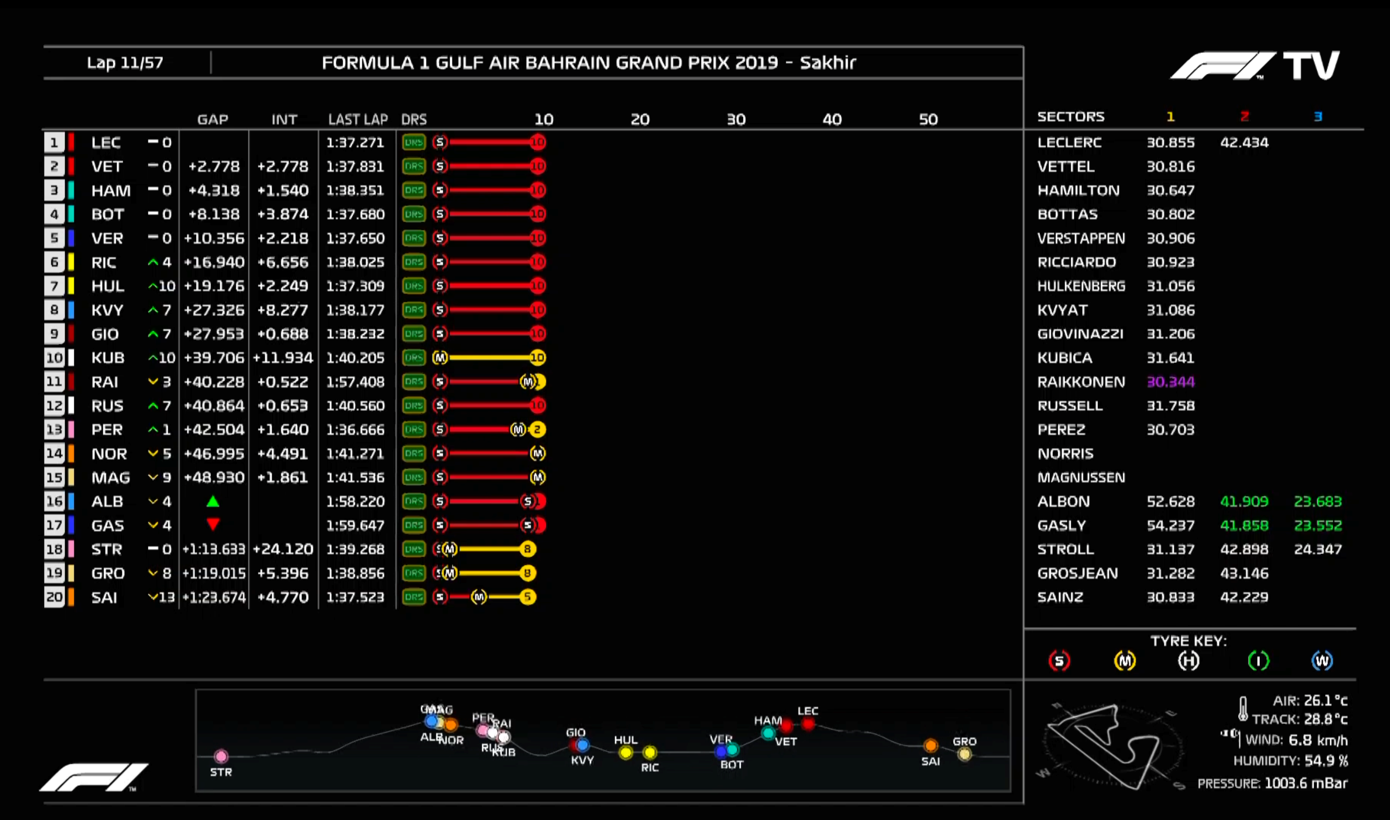

Team decisions. Most often we know them for their controversial team orders, telling a driver to let his teammate through or a brilliant pit strategy maximizing tyre life to get to the front. However there are a lot of things that are decided throughout a race weekend. Practice session plans, different fuel runs, qualifying prep, car setup, engine maps, laptime expected etc. All called from the minds of the team along with the aid of heaps of data being recorded in front of their eyes.
Typically, the strategy team works many races ahead of time. The team will use all available data to provide a complete simulation of all possible situations and their strategic consequences. Every race weekend brings a huge amount of understanding of where we are weak, strong, and how we can improve.
This means that like any team sport, the outcome for the entire event can be affected by things that may seem minor to the naked eye.

Lets briefly revisit some of these team decisions from this season.
Bahrain:
During the second half of the race, the reigning world champion Max Verstappen and Charles Leclerc got within fighting range of each other.
Pouncing on each other at Turn1 with help from their DRS. This got frustrating for both sides as the lead kept switching between them and no one was able to firmly hold the lead. Both teams were suggesting options to use for a clean overtake, like RedBull suggesting Max to use his battery more which was more effective when his was malfunctioning irregularly and Ferrari suggesting Charles to recharge more as the straight line speed advantage of the RedBull meant outright overtaking at top speeds would be difficult.

This was one of those team decisions that is more subtle than a pitstop or telling a driver to go for a fast lap. However small steps overtime added to Charles being able to take the lead and pull away, as RedBull’s aggressive strategy meant they lost performance due to overuse.
Monaco
The front-runners switched to intermediates on lap 17, with Perez taking the lead two circuits later, followed by Leclerc and Verstappen, while Sainz went straight to hards, with Leclerc following for a Ferrari double-stack. On lap 21, race leader Sainz was told he needed to pit and switch from wet to slick tyres. Both Ferrari cars pitted, with Sainz and Leclerc switching to the hard tyre.
With Sainz and Leclerc switching to the hard, this meant Leclerc dropped to fourth behind Verstappen, as the double stack of pitstops was not timed correctly making Charles lose time waiting for Sainz to complete his pitstop. Further displacing their ideal strategy, both Ferrari drivers came out behind lapped cars adding to the time they spent not putting in laptimes to catchup.

Another strategy mixup happened a bit further behind the field with Alonso and Hamilton. With Hamilton on fresh tyres and Alonso not. The Alpine pitwall asked Alonso to slow down to preserve the tyres to finish the race. This meant Hamilton got stuck behind him, not able to use the fresh rubber to put in strong laptimes.

Thank You for reading!
Find me at @devaslooper on Twitter
And
our team at https://linktr.ee/Thefastestsector
About The Author


Leave a Reply