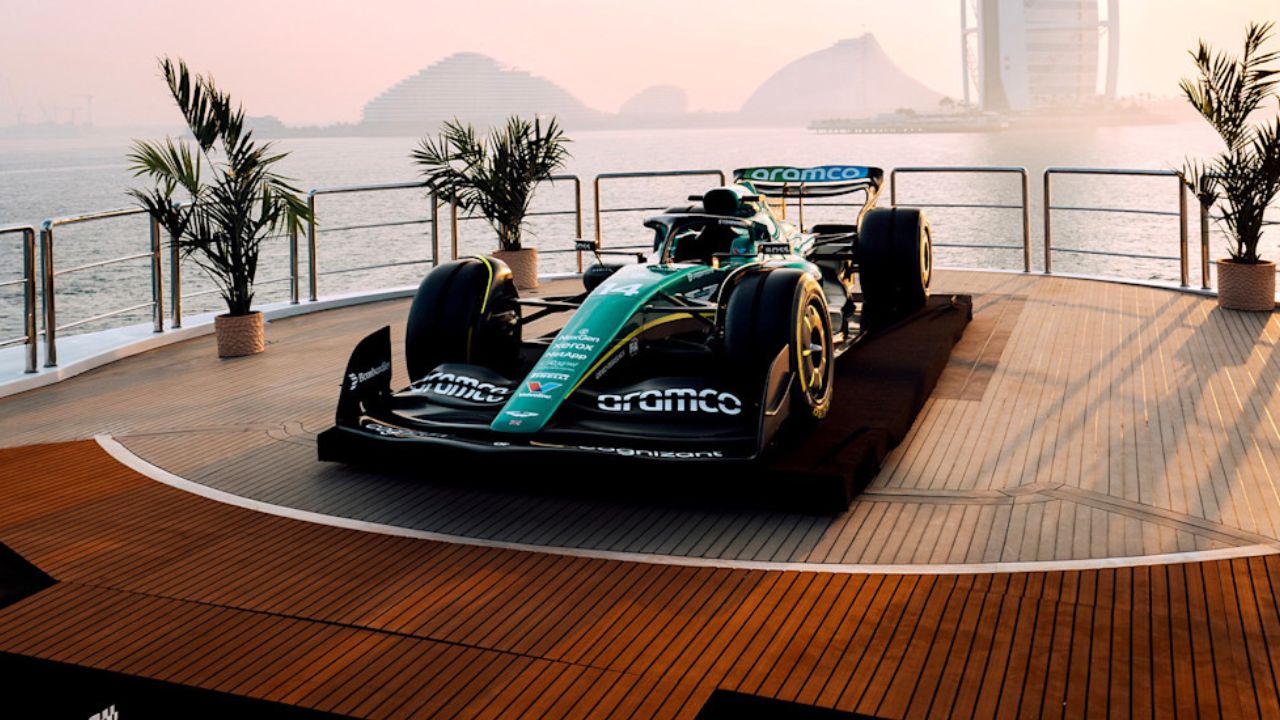

The 2025 Formula 1 season was a challenging one for the Aston Martin Aramco F1 Team. On track, the team struggled, while off track, there was a structural overhaul and major groundwork was laid for the future, especially in anticipation of the imminent regulations and engine changes due in 2026. Following a promising 2023 and a mixed 2024, the 2025 campaign highlighted the team’s limitations under the current rules, as well as their forward-looking ambition.
New Car, Same Drivers
Aston Martin unveiled their 2025 challenger, the AMR25, on 23 February, ahead of pre-season testing in Bahrain. The car featured significant aerodynamic revisions compared to its predecessor, with the aim of improving ‘driveability’ for drivers Fernando Alonso and Lance Stroll.
Alonso and Stroll returned for their third consecutive season as teammates, making Aston Martin one of only two teams to retain the same driver line-up for the 2025 season. Expectations were cautiously optimistic, with hopes that greater consistency and upgrades could help them catch up with the front-runners in the midfield.
Midfield Performance
Despite the revised car and development efforts, Aston Martin initially struggled to achieve consistent points-earning results. As part of a bid to regain competitiveness, the team brought its first major upgrade package to Imola, including new floor and bodywork aimed at increasing downforce and consistency. However, results remained inconsistent and hard-won points were few and far between.
Commentators and analysts noted the challenges facing both drivers. In particular, former Formula 1 driver Nelson Piquet Jr. criticised Lance Stroll’s season, citing his continued underperformance relative to expectations. This kind of narrative is nothing new to the Canadian, he has been dealing with it throughout his F1 career.
Nevertheless, Fernando Alonso, the team’s most experienced and high-profile driver, provided key contributions. After a challenging campaign overall, he finished the year strongly by scoring points in the Abu Dhabi finale.
Infrastructure and Technical Strategy
While the results on the track were mixed, Aston Martin’s off-track developments were arguably more consequential for their long-term trajectory. A significant milestone was the operational launch of the new Silverstone wind tunnel, which is said to provide better aerodynamic testing and higher-fidelity data than the previous setup. According to the team’s leadership, this tool is essential for improving the AMR25 and future cars, especially the important 2026 model.
Alongside infrastructure upgrades, the team underwent major leadership changes. In late 2025, Aston Martin confirmed that Adrian Newey would take over as Team Principal in 2026, while retaining his technical leadership role. This reshuffle positions Newey at the strategic core of the team as it transitions into a new regulatory cycle.
These adjustments reflect a broader strategy of building long-term competitiveness around the 2026 technical overhaul rather than chasing ephemeral gains under the outgoing 2025 regulations.
Championship Standing
By the end of the season, Aston Martin was languishing in the lower points-scoring zones of the constructors’ standings. Ultimately, the team finished around seventh, partly thanks to Alonso’s efforts towards the end of the season. While industry analyses highlighted this as an improvement on previous mid-season struggles, it was still short of consistent podium contention.
This was in line with the expectation that the 2025 Aston Martin campaign would be more developmental than competitive, especially compared to top teams such as Red Bull, McLaren and Mercedes. Some pundits suggested that teams prioritising 2026 development over the short term might accept stagnation for long-term gain.
Reserve Drivers and Future Talents
Aston Martin also continued to invest in its driver development program. Brazilian racer Felipe Drugovich was confirmed once again as Test and Reserve Driver for 2025, marking his third consecutive year in that role. Drugovich brought extensive testing experience and has been a key part of Aston Martin’s simulator feedback loop, alternating duties with fellow reserve Stoffel Vandoorne.
Meanwhile, ahead of 2026, the team appointed Jak Crawford as its official third driver. Crawford, a rising talent from the Young Driver Development Programme, has already accumulated valuable road car time and simulator work and will be involved in supporting both race operations and development of the next car.
Looking ahead to 2026
For Aston Martin, the defining narrative is not so much the results for 2025, but the bold repositioning for 2026, driven by regulatory changes and a new partnership with Honda for engine supply. The team’s collaboration with Honda, who will provide power units from next season onwards, represents one of the sport’s most significant technical shifts. This partnership offers a fresh performance baseline and opens up new strategic possibilities.
As 2026 approaches, drivers, engineers, and stakeholders are looking forward to the next chapter: a new era of Formula 1 defined by regulations, the landscape of power units, and the leadership of Newey. While far from triumphant, Aston Martin’s 2025 season thus serves as a pivotal bridge year, balancing on-track effort with foundational change off it.
Featured Image Credit: Aston Martin

Jessica Alfieri
Edited by Alexandra.
About The Author


Leave a Reply