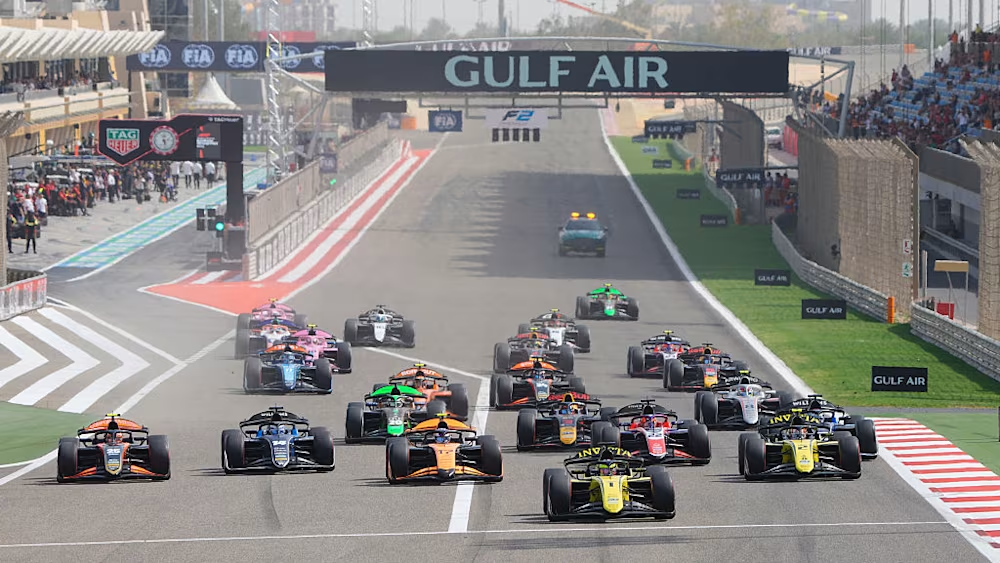

Formula 2 is often described as a stepping stone – a fixed point on the ladder to Formula 1 that every aspiring driver must go through. But by the time drivers reach the Formula 2 grid, many are no longer just “young prospects.” They arrive carrying expectations that have been built up over the years, often already embedded within a Formula 1 structure. Teams begin scouting talent as early as karting, meaning that by the time a driver enters Formula 2, they may have spent seasons — and sometimes an entire career — under the backing and scrutiny of an academy. Formula 2 represents the ultimate proving ground — the final opportunity for drivers to show they are ready for a place in Formula 1.
No Place to Hide
The structure of Formula 2 is deliberately built to expose every aspect of a driver’s skill set. Qualifying rewards outright pace and precision, while the Sprint Race, with its reversed top-ten grid, forces drivers to fight through the field and test their race craft, adaptability, and decision-making abilities under pressure. Over the years, many highly rated drivers went through the feeder system under the backing of major academies, from Callum Ilott and Mick Schumacher within the Ferrari Driver Academy to more recent prospects like Isack Hadjar and Arvid Lindblad in the Red Bull programme.

However, not all of them share the same outcome. Despite the equal machinery in Formula 2, performance is not the only variable at play. Time, pressure, and race results become decisive factors in the final calls made by academies, often shaping careers as much as, if not more than, raw speed. In most cases, drivers are given no more than two seasons to prove themselves.
But this is no guarantee. The pressure is, undoubtedly, immense. Some drivers such as Oscar Piastri succeed immediately, going on to win the title as rookies. However, this is not always enough to secure an immediate place in Formula 1. Others, who are just as talented, do not always follow the same path. Drivers like Victor Martins have shown speed and potential, but have failed to translate it into the kind of results or momentum required to move forward at the same pace.
The Breaking Point
If there is a point where pressure truly peaks, it is in Formula 2. Unlike Formula 1, where drivers arrive with contracts and relative stability, Formula 2 offers no such security. Every session carries weight, every mistake is magnified, and every comparison is immediate. Even drivers who would go on to establish themselves in Formula 1, such as Pierre Gasly or Alexander Albon, experienced how quickly momentum can shift in the Red Bull system. The margin between being considered “ready” and being overlooked is often measured in a handful of races — or even a single weekend.
This pressure is only amplified by a structural reality. Formula 2 is not a ladder, but a bottleneck. The number of drivers backed by academies continues to grow, while seats in Formula 1 remain limited and largely occupied. As a result, Formula 2 becomes an overcrowded space where multiple “F1-ready” drivers coexist, but only a fraction can progress. Cases like Nyck de Vries or Felipe Drugovich illustrate this imbalance — champions who proved their worth in F2, yet found opportunities in Formula 1 delayed or restricted. In this context, performance is not a differentiator on its own, but a minimum requirement in an increasingly saturated system.

Internal Competition
Within this environment, competition is not only external, but deeply internal. Academy drivers are often fighting for the same future seat, sometimes even within the same team structure. The Red Bull programme, in particular, has long exemplified this dynamic, with multiple junior drivers evaluated against each other simultaneously, creating direct and relentless comparisons, seen through the likes of Isack Hadjar, who has just stepped up to Red Bull Racing, and Arvid Lindblad, who entered Formula 1 still underage.
In Formula 2, your closest benchmark is not just the driver ahead of you on track, but the one sharing your backing — the one you must outperform to remain relevant. It is a form of competition that goes beyond results, shaping decisions long before any promotion is officially considered.
Ultimately, this is what defines the role of academies in Formula 2. They open doors, but they can just as easily narrow them. They create opportunity, while simultaneously enforcing selection. And in a category where time is limited, pressure is constant, and competition is internal as much as external, Formula 2 stops being a simple step towards Formula 1 and becomes the place where careers are truly decided.
Feature image: Formula2
Edited by Reo Lane.
About The Author


Leave a Reply