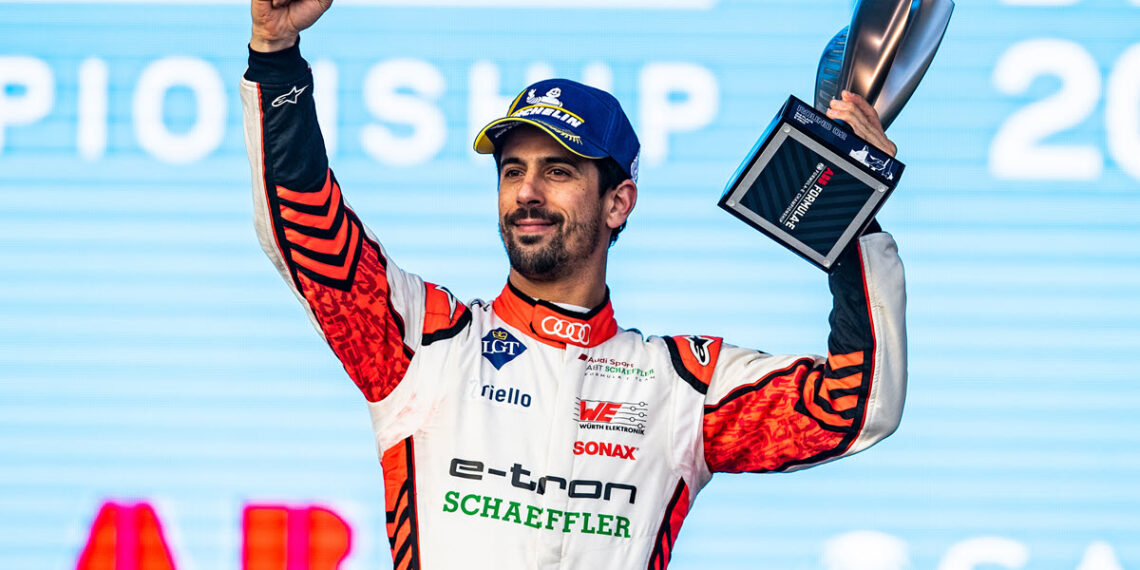

There are drivers who come and go in Formula E. And then there’s Lucas di Grassi. Because this isn’t just another retirement. The Brazilian has confirmed that 2026 will mark his final season in professional racing, ending a career that has been tied to Formula E almost from the very beginning. In a video shared on Instagram, he described it as “a lifetime dedicated to racing,” reflecting on a journey that has been as much about belief as it has been about results. And that distinction matters. Because di Grassi didn’t arrive in Formula E when it was already established. He helped build it.
Back in 2014, when the championship was still an unknown, he was one of the first drivers to commit, taking a risk on a series centred around electric racing, sustainability and a completely different identity to anything else in motorsport at the time. In that same video, he spoke about believing in the project “from the beginning,” long before it had the credibility it holds today.
From that point on, he became a constant. He won the very first race in Beijing, immediately placing himself at the centre of the championship’s story. And from there, through every evolution of Formula E, from its early, experimental years to the polished, manufacturer-heavy grid it is now, di Grassi remained.
His statistics underline that consistency.
A world championship in 2016–17.
13 wins.
41 podiums.
Over 1,000 points.
But even those numbers don’t fully explain his importance. Because, as he suggested in that Instagram video, this was never just about what he achieved on track. It was about the journey; the risk of joining something unproven, and the satisfaction of seeing it grow into something real. That’s why this retirement feels different.
When di Grassi steps away at the end of the season, Formula E doesn’t just lose a driver; it loses one of its original believers. One of the few who were there from Season One and stayed long enough to see what it became.
More than a champion: the teams, the rivals, the legacy
Part of what defines di Grassi’s Formula E career is not just how long it lasted, but where it took him. His most iconic period came with Audi Sport ABT Schaeffler, where he became synonymous with the brand’s early success in the championship. It was there that he secured his 2016–17 title, consistently fighting at the front and helping establish Audi as one of the benchmark manufacturers of Formula E’s early years.
Even before Audi’s official entry, his connection with ABT ran deep and made him one of the most recognisable faces on the grid during the championship’s formative seasons. After Audi’s departure, di Grassi’s career took on a different role.
Moves to teams like ROKiT Venturi Racing and Mahindra Racing weren’t just about chasing wins, they were about experience, leadership, and helping teams navigate an increasingly competitive and technical era of Formula E. It mirrored what he spoke about in his retirement video: contributing to something bigger than just results. Because by that stage, di Grassi wasn’t just racing the grid, he was part of the structure of it.
And to understand his legacy properly, you have to look at the names he raced alongside. Drivers like Sébastien Buemi and Jean-Éric Vergne defined Formula E’s competitive edge. Buemi, with his relentless consistency in the early years. Vergne, as the only double champion, setting the benchmark in the Gen2 era.
Di Grassi sat right alongside them. Not always dominating in the same way, but he was always there, always relevant. Always capable of stepping back into the spotlight when it mattered. Because while some drivers had peaks, di Grassi had longevity.
He adapted through rule changes, car evolutions, and shifts in team dynamics. He remained competitive as the championship became faster, more complex, and more crowded with manufacturer-backed talent. Few drivers managed that transition as effectively. Even fewer did it from the very first race to the modern era. Which brings it back to now.
In that Instagram video, di Grassi doesn’t frame his retirement as an ending in the traditional sense. There’s no dramatic finality to it. Instead, it feels like someone stepping away knowing the project they believed in has reached a point where it no longer needs them in the same way. He arrived when Formula E needed pioneers. He stayed long enough to see it become a destination.
What di Grassi’s exit actually means for the grid
On paper, di Grassi leaving Formula E is just one seat opening up for 2026/27. In reality, it’s a lot more than that. Because when someone who has been there since the beginning disappears from the grid, the impact isn’t immediate in results, it’s structural.
At a basic level, his departure creates an opportunity. A younger driver comes in. A rookie gets a shot. Maybe a Formula 2 graduate, maybe someone already within the Formula E system. But replacing di Grassi isn’t as simple as filling a seat. Because teams don’t just lose pace, they lose experience.
He’s spent over a decade understanding Formula E’s unique racing style: energy management, strategy, unpredictability. The kind of knowledge that doesn’t show up on a timing sheet but often decides races. For teams navigating the next phase of the championship, that matters. And the timing couldn’t be bigger. His retirement comes right on the edge of Formula E’s next major shift — the Gen4 era.
In simple terms:
- New car
- New performance window
- Less experience on the grid
That combination usually leads to instability early on. And without someone like di Grassi actively racing, that adjustment period could be even more unpredictable. There’s also a quieter shift happening. For years, Formula E has had a core group of reference drivers: di Grassi, Buemi, Vergne; names that understood the championship inside out. With di Grassi gone, that group shrinks again.
And it pushes responsibility onto the next generation, drivers who are quick, but haven’t lived through every phase of Formula E’s evolution. That changes how the grid feels. Less anchored. More fluid. And then there’s the part that’s harder to quantify. Formula E has always been built on evolution: new cities, new cars, new manufacturers — but it’s also always had continuity through drivers like di Grassi.
Take that away, and something subtle shifts. Fewer links to Season One. Fewer drivers who remember how uncertain it all once was. And that changes the story of the championship. Not everything will change. The racing will still be close. The unpredictability will still be there. New stars will emerge, they always do.
But the grid loses:
- One of its most experienced drivers
- One of its key technical voices
- One of the last remaining links to where it all began
And those aren’t things you directly replace. You just move forward without them. Which is why this isn’t just about who takes his seat. It’s about what Formula E looks like once one of its originals is no longer part of the picture. And next season, for the first time in a long time, we’re going to find out.
Feature image credit: Green Racing News
About The Author


Leave a Reply